- Municipal status, a control demonstration, a manual and a measured performance record answer different questions.
- A result needs identified equipment, configuration, method, location, units and a relevant acceptance target or source.
- Read verified, deferred, corrected and unassessed items separately; available documents do not imply a national entitlement to one commissioning package.
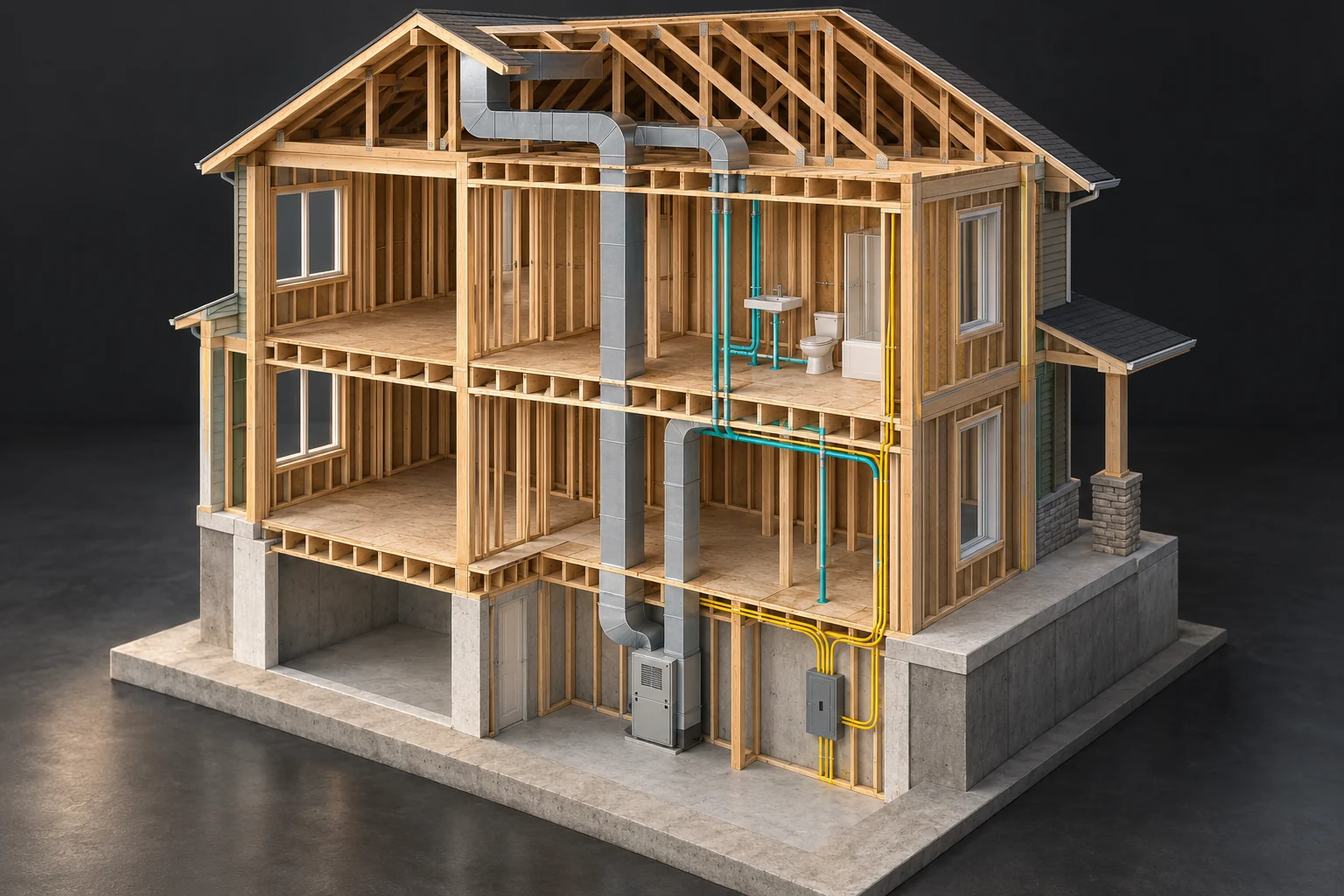
Visible routes locate different system functions. Closed equipment keeps this a planning illustration.
About this illustration
Capacity, continuity, hidden condition, electrical safety and actual delivered performance are not established. This is a conceptual teaching model, not an assessment of your home.
3 picture lessons appear beside the questions in this guide. Use them to understand the explanation, then consider what it means for your home.
What does commissioning add when the home already passed an inspection?
Start with the exact claim you want to understand. A municipal inspection result relates to the authority’s recorded scope and stage. A control demonstration shows how a feature responds at that time. A manual explains the identified product. A commissioning record connects the installed system to a defined verification: what was checked, under which conditions and against which basis.
Calgary’s new-house process identifies separate construction and trade inspections. Request the applicable records without rewriting them as a complete measured assessment of every room or operating mode. Conversely, a ventilation report is not a substitute for the municipal approvals. The value comes from keeping each document attached to the question it actually answers.
BC Housing’s January 2025 commissioning guidelines distinguish installation/start-up checks from functional verification of intended operation. They apply to that organisation’s project context, not automatically to a private house bought in British Columbia. The useful educational principle is to ask for the named verification and its scope, rather than treating a final checklist tick as an all-system guarantee.
Which equipment, configuration and test points belong to the result?
A report should make the assessed system recognisable later. Look for the address or project reference, equipment model and identifying tag or serial information, date and responsible person. Ask what was connected when the result was obtained. A proposed design drawing and a record of the installed arrangement provide different information if construction changed the route or controls.
A measurement also needs an identified boundary. Airflow at a ventilation unit is different from airflow at a particular bathroom connection or bedroom grille. Water observed at one fixture says little about concealed joints elsewhere. An electrical approval needs its actual installation scope; it is not evidence that every feature of a separate ventilation controller performed as intended.
Write the location in ordinary terms as well as any technical tag: ensuite exhaust connection, ventilation unit supply stream, or upper-bedroom delivery point. Ask the trade to explain an ambiguous location. A skeleton drawing can help locate those questions, but cannot establish actual duct connectivity, safe electrical access or the measuring point used at your property.
A route is different from a tested system
Visible routes locate different system functions. Closed equipment keeps this a planning illustration.
Numbers identify the parts explained below.
- Routes
Trace the question using records; colour is only this illustration’s key.
- Closed equipment
A professional defines access and measurements. Do not open a panel for this lesson.
- Room endpoint
A symptom at one room does not locate the fault.
What does this illustration leave out?
Capacity, continuity, hidden condition, electrical safety and actual delivered performance are not established. This illustration explains an idea. It is not an installation guide.
Which safe observations and specific professional measurements would resolve this system question?
Explore this with HomeAI ↗Opens an editable question. Nothing is sent until you choose to send it.What makes an acceptance target more useful than “good”?
A useful conclusion relates a finding to an identifiable requirement or intended function. Ask whether the basis is the project’s ventilation design, the exact equipment instructions, an applicable local requirement or a documented contract specification. Keep the source and its applicability beside the result. A catalogue maximum and an installed design target are different claims.
The National Research Council explains that national model codes are adopted through provincial and territorial systems. That means a number copied from an online example is not automatically the target for this home. Ask the responsible professional to identify the relevant jurisdiction, installation and applicable edition or specification when they invoke a compliance limit.
If the report simply says within range, ask which range, for which mode and from which document. If it gives a measured value without a target, retain the result and mark the comparison unresolved. Do not invent a pass or fail while waiting. A clear missing acceptance basis is an actionable document question; it is not proof that the equipment failed or that the builder owes every requested test.
How does an operating demonstration differ from functional verification?
During normal owner orientation, learn what the ordinary controls command and what response is expected. Tarion’s Ontario PDI guidance describes explaining systems and recording incomplete, inaccessible or inoperative items for enrolled homes. That makes a demonstration useful evidence about use and the observed response, without automatically turning it into a measured performance test.
If a bathroom boost button changes fan noise, record the demonstrated command and response. It does not independently quantify exhaust at that room. If the thermostat calls for heat and warm air appears, that is useful basic operation; it does not establish room-by-room delivery or every future weather condition. Attach the actual control/manual identification to the demonstration.
Functional verification asks whether the intended response occurred under the agreed test conditions. Some questions need measurement, while others concern a documented control sequence or qualified safety check. Ask the contractor which method fits the claim. Buyers should not operate service menus, alter wiring, bypass safeties or simulate equipment failures to imitate professional testing.
What should a ventilation balancing record distinguish?
For an HRV or ERV, identify the supply and exhaust streams separately. Health Canada describes balanced ventilation as coordinating those flows; recovery of heat or moisture is another function. A product’s rated capacity or a seller’s statement that the system is balanced supplies neither the installed readings nor their measurement context.
The Canadian Venmar/vänEE K/Bronze manual gives a model-specific example: its installer balancing section depends on configuration, filter condition, selected speed and the relationship to a furnace blower. It also calls for a nearby reference label with date, maximum-speed airflows and installer contact information. Those details illustrate why conditions and responsibility belong with a result; the manual’s procedure and tolerance should not be copied to another unit.
Ask for the actual model, tested mode, identified streams or room points, method, instrument or documented device-derived method, readings and units, relevant conditions and applicable target. Unit balance does not alone establish every room’s distribution or the cause of a moisture complaint. Preserve bathroom-specific evidence and later observations separately, rather than converting one total-flow report into an answer about every room.
Air routes and energy exchange are different
Separate routes illustrate distribution and ventilation functions. Heat or moisture transfer does not require an air bypass.
Numbers identify the parts explained below.

- Outdoor interface
Weather and smoke conditions affect the ventilation question.
- Equipment
Use the manual and commissioning record to identify its actual functions.
- Room delivery
Distribution needs its own observations; equipment age cannot establish airflow.
What does this illustration leave out?
Actual airflow, balance, leakage, filtration, settings and commissioned operation are not measured here. This illustration explains an idea. It is not an installation guide.
What measurements and commissioning records distinguish ventilation, recirculation and heating or cooling distribution?
Explore this with HomeAI ↗Opens an editable question. Nothing is sent until you choose to send it.Which heating or cooling claim was actually verified?
Define the intended claim before collecting an impressive-looking service sheet. Equipment start-up, a control sequence, distribution and room comfort are connected but distinct. Ask the HVAC contractor what the model-specific setup and verification covered, which measurements were made and which modes could be assessed under the conditions available.
For gaseous appliances in Ontario, TSSA’s current linked advisory assigns commissioning responsibilities to appropriately certified people and distinguishes those responsibilities from a distributor’s initial inspection. It also recognises that the installer and commissioner can be different parties. This is a named provincial example of accountable roles, rather than a Canada-wide trade credential or a buyer’s permission to operate tagged equipment.
Enbridge Gas Ontario identifies an appliance installer validation form within its process and distinguishes optional due-diligence templates. Ask the builder or trade which applicable records exist for the home. A signed form can be useful, but read what it attests to before assuming it contains room airflow, cooling performance or a complete combustion report. Missing seasonal evidence should remain a specifically scoped follow-up question.
How do I ask about plumbing and electrical functions without a generic test list?
Name the feature and consequence that matter at this property. For plumbing, the question might concern the normal control demonstration for an installed water heater or the evidence for a specific completed leak investigation. For electrical work, it may be the approval record for the installed scope and the documented response of a particular control. Ask the responsible trade which verification is applicable.
Avoid requesting a supposed national bundle of every possible pressure, temperature, electrical or alarm test. Building type, equipment, project scope and local requirements determine what is relevant. Calgary’s separate trade inspection records illustrate that plumbing, electrical and gas approvals need their own identities; one inspection heading should not silently stand in for another system’s measured operation.
For shared equipment, establish who holds the records and who is authorised to arrange assessment. A unit purchaser may need the condominium or building manager’s involvement. Ask for an explanation of the actual scope and remaining limitation. Do not remove a panel cover, operate a safety-relief valve or disturb a sealed pump assembly to fill a documentation gap during a walkthrough.
Why do dates and later changes matter to commissioning?
A result describes the system and condition assessed on its recorded date. Compare that date with completion of the installation and any relevant later change. A ventilation result obtained before a duct alteration or a filter-cabinet substitution cannot automatically certify the changed arrangement. Ask which part was rechecked and where that subsequent record is retained.
Distinguish an unassessed mode from a failed check. An unavailable seasonal condition may leave a defined performance question open, whereas a demonstrated malfunction needs its own observed finding and response. Request a named person, intended verification and follow-up arrangement for each outstanding item. Do not label either category passed simply because the house was handed over.
When corrective work occurs, retain the original issue, the work performed and the evidence used to close it. A replaced component is a completion fact; the relevant recheck explains whether the original functional question was answered. Neither a different date nor a clean new invoice proves that all adjacent systems or later conditions were assessed.
See what finishes can conceal
Open framing, insulation specimens, closed equipment and an illustrative buried sanitary route are exposed.
Numbers identify the parts explained below.
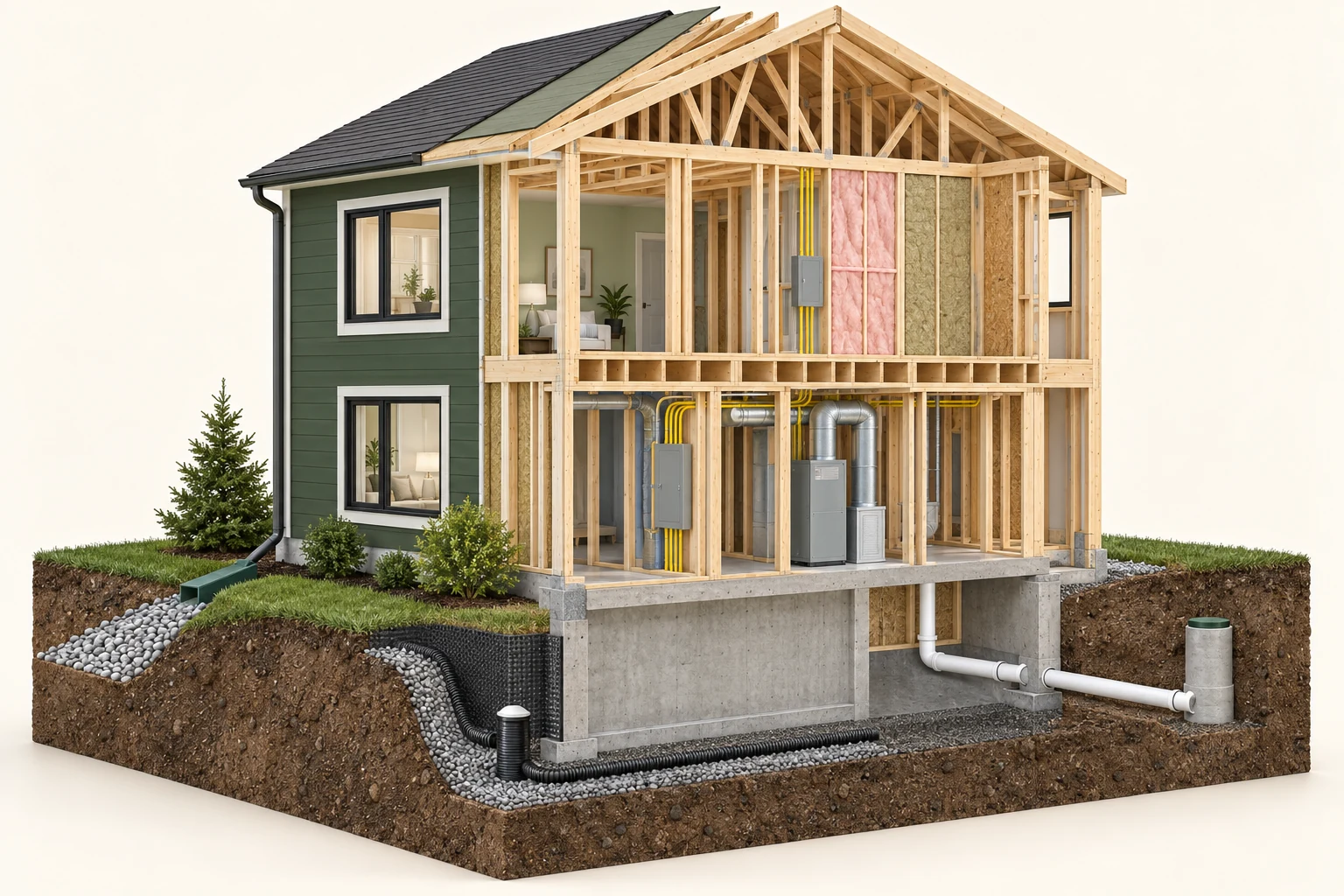
- Exposed stage
Stage records can document specific work before it disappears behind finishes.
- Closed services
Ask for installation, inspection and commissioning records; keep hazardous equipment closed.
- Buried routes
The white sanitary route and dark foundation-drainage context are separate. Gaps are cutaway simplifications, not a defect finding.
What does this illustration leave out?
Member capacity, connections, assembly continuity, commissioned performance and pipe support are not certified by this model. This illustration explains an idea. It is not an installation guide.
Which new-build stages and commissioning records should I review, and what remains outside each inspection scope?
Explore this with HomeAI ↗Opens an editable question. Nothing is sent until you choose to send it.How would a fictional buyer read an incomplete ventilation packet?
A fictional buyer receives a municipal inspection status, an HRV manual and a sheet saying ventilation balanced. A control demonstration changes fan noise, but the sheet contains no identified streams, mode, readings or acceptance basis. These documents provide some genuine context within the example. They do not establish a defect, and the blank measurement context remains visible.
The buyer asks the builder who verified the installed system and requests the report or an explanation of the verification method. Suppose a later record identifies the unit, two stream results and the assessed mode, but does not cover an ensuite complaint or a later duct modification. The buyer records those exclusions and asks the ventilation professional to define the remaining scope.
After the relevant correction and recheck, the file connects the original concern with the work and the measured or demonstrated outcome. The buyer also retains normal-use instructions. No fictional litres-per-second value, universal tolerance or warranty deadline is needed. The case teaches how to recover a defensible chain of evidence without calling a missing form a failed home or treating one result as complete coverage.
What is the next useful evidence request before handover?
Choose one unresolved functional claim and write a compact request: identify the system, explain the verification performed, supply its conditions and acceptance basis, and name the remaining limitation. Ask whether the relevant existing record can answer it before commissioning another assessment. This makes the request concrete enough for the builder or trade to respond.
Keep the result, normal operating instructions and any outstanding item together, with the responsible contact. If the meaning is unclear or the consequence is substantial, an appropriately qualified independent specialist can review the record and define additional work. Their scope should identify the system and question, rather than promising to certify everything about the new home.
Contractual availability, municipal compliance and warranty rights are separate questions. Alberta’s official warranty overview concerns registered homes, providers and coverage categories; it does not promise this guide’s suggested record package for every Canadian purchase. Use the actual provincial/provider process for those decisions. The practical outcome here is narrower and valuable: you know what was verified, what it means and what still needs an answer.
Keep learning about the connected parts
- Buying a home with propane: understand the tank, supply and handover
- Buying a home with a standby generator: engine, switching and handover
- Buying a condo before completion: connect the future unit, contract and closing stages
- Buying an owner-built home: permission, construction evidence and protection
Practice the distinction.
A balance statement without its readings
Fictional learning scenario: a new-home buyer has approvals, a manual and a short ventilation statement with missing test context.
Reported observations
- The unit control was demonstrated.
- The initial sheet contains no streams, mode, readings or acceptance basis.
- Later documentation describes only one mode.
- A room complaint and a later duct change need their own scope.
Compare the explanations
Expand each possibility to see the evidence needed to distinguish it. Similar symptoms can have different mechanisms.
Verification exists but its record is incomplete
A short handover statement may omit evidence available from the responsible trade.
Identified equipment, original report, method, readings, conditions and interpretation.
Additional defined verification remains necessary
The available mode or earlier configuration may not answer the later room question.
A scoped professional review of the change, relevant room points and follow-up record.
A useful next question
Request the existing traceable result first, then define the remaining verification with the responsible qualified professional.
The case gives no universal testing bundle, commissioning entitlement, code target or warranty decision.
Know what the words mean.
- Commissioning record
- Evidence identifying what installed-system verification occurred, its conditions, findings and interpretation.
- Functional verification
- Assessment of whether an identified system or control performs its intended function under defined conditions.
- Acceptance basis
- The applicable design, manufacturer, contract or local requirement used to interpret the stated result.
- Configuration
- The equipment, connections, controls and operating arrangement present when the check was performed.
- Deferred verification
- A named assessment not yet performed under the required available conditions, kept separate from a failed finding.
Questions to bring
to the conversation.
- Which system and equipment does each record identify at this address?
- What operation or measurement was actually verified, in which configuration and conditions?
- What design, manufacturer or applicable local basis supports the acceptance target?
- Which findings were corrected and rechecked, and which modes remain deferred or unassessed?
- Who will explain normal use and supply the missing evidence without asking the buyer to perform trade testing?
Separate a showing observation, an existing record and a new professional assessment. Unknown means a question remains; it does not automatically mean a defect.
Use the evidence planner ↗Go to the source.
Original HomeAI explanation informed by these public references. Sources support the underlying guidance; they have not reviewed or endorsed HomeAI. Diagrams are conceptual, and calculator outputs depend on your inputs.
Publication & source review
First published .
Sources reviewed .
- Health Canada · Ventilation and the indoor environment
- City of Calgary · New-house inspections and trade scopes
- Tarion · Ontario pre-delivery inspection and systems orientation
- Government of Alberta · New home warranty overview
- National Research Council Canada · Codes Canada frequently asked questions
- BC Housing · Building Commissioning Guidelines, January 2025
- Venmar/vänEE · K/Bronze Series user and installer manual 21777J
- Technical Standards and Safety Authority · Commissioning and putting gas appliances into use
- Enbridge Gas · Ontario builder/HVAC inspection and installer validation resources
Have a question about your home?
Start with the symptom, timing and what you have observed.
Ask HomeAI