- Household return/supply air, heat transfer and combustion intake/venting have different jobs. A cabinet or pipe count cannot establish the complete installed arrangement.
- Condensate, cooling equipment and controls belong to the actual covered model and configuration; a generic furnace diagram cannot approve them.
- Ask what replacement work, final commissioning and current professional assessment actually cover, including retained appliances and later room changes.
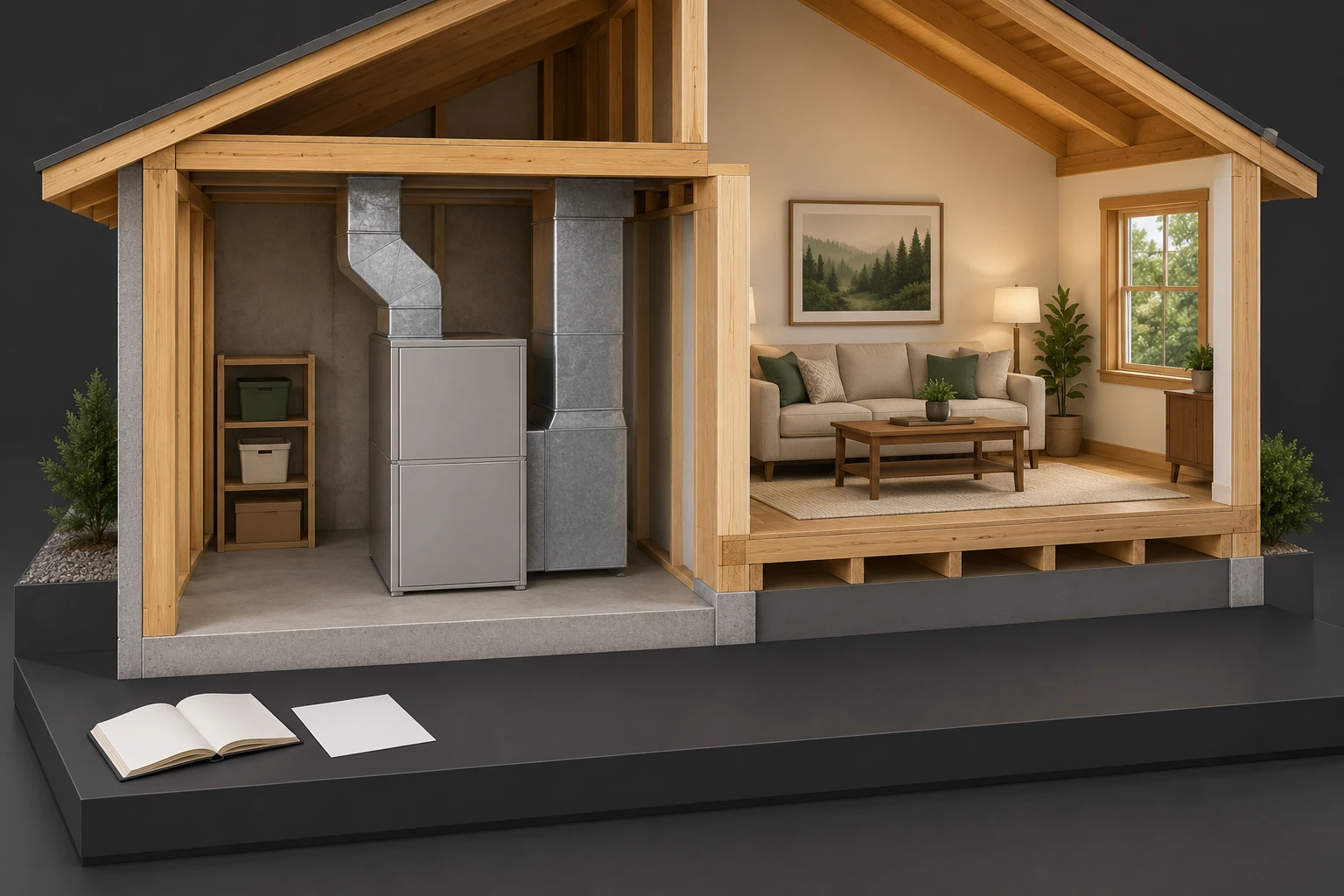
A closed plain cabinet stands in an unfinished equipment-space illustration beside two broad metal duct-like forms. A timber-framed adjoining furnished room and separate blank booklet and sheet locate household and record questions.
About this illustration
No actual fuel, connected return or supply route, combustion intake, exhaust termination, condensate route, heating capacity, support adequacy, room airflow or equipment condition is established. The adjoining duct-like form is not visibly connected to the cabinet. No combustion or safe-operation test is depicted. This is a conceptual teaching model, not an assessment of your home.
9 picture lessons appear beside the questions in this guide. Use them to understand the explanation, then consider what it means for your home.
What does the word furnace tell a buyer?
Start with the heat source and the way heat reaches rooms. This lesson explains documented fuel-burning forced-air arrangements, using a named gas-furnace family as an example. It does not give every appliance called a furnace the same combustion route. An electric furnace, a heat pump and a boiler feeding water-based emitters need their own equipment explanation. A furnace-shaped cabinet in a listing photograph does not establish fuel, the connected appliances, operating condition or the spaces served. Existing installation documents and the responsible provider should identify the actual system without opening equipment.
The examples have explicit limits. NRCan’s Heating with Gas is the Revised October 2012 explanation, not today’s regulations or prices. Lennox’s currently hosted EL297UHE installation and owner instructions carry April 2024 and July 2023 printed editions. A dated Canadian product-line sheet identifies the EL297E family, and the exact support listing identifies EL297UH110XE60C while marking replacement availability. These sources support component roles; they do not select this model for your home, establish current stock or prove the pictured installation matches it.
Connect the equipment question with the rooms it serves
A closed plain cabinet stands in an unfinished equipment-space illustration beside two broad metal duct-like forms. A timber-framed adjoining furnished room and separate blank booklet and sheet locate household and record questions.
Numbers identify the parts explained below.
- Closed equipment landmark
Identify the actual heat source and model from existing records or qualified assistance. Cabinet appearance alone does not establish gas, electric or heat-pump operation.
- Broad household duct forms
Supply and return have distinct household-air roles. These broad forms are landmarks; the precise conceptual relationship appears in the sourced comparison rather than a claimed installed connection.
- Rooms and handover scope
An equipment change, a room-comfort account and a completed handover answer different questions. The furnished room and blank papers contain no measured delivery or actual assessment.
What does this illustration leave out?
No actual fuel, connected return or supply route, combustion intake, exhaust termination, condensate route, heating capacity, support adequacy, room airflow or equipment condition is established. The adjoining duct-like form is not visibly connected to the cabinet. No combustion or safe-operation test is depicted. This illustration explains an idea. It is not an installation guide.
Which actual equipment, distribution and room-delivery evidence follows the home through this purchase?
Explore this with HomeAI ↗Opens an editable question. Nothing is sent until you choose to send it.How does heat pass into household air?
In the gas example, burning fuel releases heat into the combustion-side passages. The heat exchanger provides heat-transfer surfaces so that useful heat can pass to the household-air side. The intended job is heat transfer across a boundary; combustion products are not the household supply air. NRCan describes additional heat-exchange surfaces in a condensing furnace that recover heat from combustion by-products before exhaust. The named installation manual separately warns against combustion or flue products entering the return-air system or living space. These two statements explain why identifying separate routes matters.
An intact-looking outer cabinet does not show the exchanger’s internal condition. Neither warm air at a register nor a quiet alarm establishes the integrity of that boundary. A professional heat-exchanger assessment has its own scope, access and limitations, separate from asking whether a bedroom receives enough heat. For a buyer, useful understanding means being able to name both questions without collapsing them into one claim that the furnace works. A conceptual picture can clarify the jobs of the parts while leaving actual integrity, concealed connections and measured operation unknown.
Keep heat transfer, household air and loose specimens separate
One rounded metal blower-like wheel, an abstract smooth curved metal boundary form and loose neutral pipe and drain-like shapes sit apart on timber. A blank booklet and lined blank sheet remain separate. There are no connected routes or open liquid-coil stubs.
Numbers identify the parts explained below.

- Household blower-like form
The household blower moves room air in the documented forced-air example. A separate combustion inducer has a different job; it is described in the guide and is not shown here.
- Abstract metal boundary
Heat transfers across the documented exchanger’s metal boundary while the two streams have separate jobs. This sealed teaching form supplies no actual internal geometry or integrity finding.
- Loose pieces and records
Neutral shapes and blank pages introduce configuration and evidence questions. They do not identify an approved vent, trap, drain, material, connection or completed service report.
What does this illustration leave out?
The abstract metal form identifies no actual heat-exchanger assembly or integrity. The single wheel is not a depicted combustion inducer. No fuel, flow, component compatibility, pipe material, vent configuration, condensate arrangement, pressure, capacity or installed condition is established. This illustration explains an idea. It is not an installation guide.
What did the actual assessment establish about combustion, heat transfer and household-air delivery separately?
Explore this with HomeAI ↗Opens an editable question. Nothing is sent until you choose to send it.Heat crosses a boundary; the air streams have separate jobs.
The relationship belongs to a documented fuel-burning forced-air furnace. An electric furnace, hydronic boiler and heat pump need their own heat-source explanation.
- Combustion side: air and fuel → combustion → exhaustThe documented gas furnace has a combustion-air and fuel-burning process, a heat-exchanger passage and an exhaust route. The combustion inducer belongs to this side’s movement; it is not the household-air blower.
- Heat-transfer bridge: across the exchanger’s metal boundaryHeat transfers from the combustion side through the exchanger to household air. The teaching relationship depends on separation; it does not show intended mixing of combustion products into the supply air or establish an actual exchanger’s condition.
- Household side: rooms → return → blower and exchanger exterior → supply → roomsThe household blower circulates room air through the distribution system and across the heat-transfer surface. A supply-temperature or comfort account addresses a different question from combustion or exhaust evidence.
- Combustion-air origin depends on the identified configurationThe reviewed EL297UHE instructions distinguish direct-vent and non-direct-vent arrangements. An outdoor intake cannot be imposed on every furnace, and household return air is not automatically its combustion-air source.
Separate conceptual relationships, not installed duct or vent geometry, fuel identification, exchanger-integrity proof, efficiency measurement or operating clearance. Keep panels closed; no test, gas adjustment or airflow challenge is supplied.
Lennox · EL297UHE User’s Information Manual (508388-01, 07/2023), Lennox · EL297UHE Installation Instructions (508386-01, 04/2024) and NRCan · Heating with Gas (Revised October 2012) (revised October 2012, historical physical explanation). Relevant full bodies reviewed October 4, 2026; Canadian-market identity and local scope remain separate.
Why are the circulating blower and combustion inducer different?
The EL297UHE parts illustration identifies a blower motor and a combustion air inducer separately. The household blower supports the air-circulation route through the furnace and ducts. The inducer belongs to the documented combustion-and-vent operation. The installation manual’s heating sequence gives these components different actions rather than treating every fan sound as household heat delivery. A thermostat call, combustion operation and circulating air are related events, but hearing a motor does not identify which job is occurring or demonstrate that all stages completed properly.
Keep that explanation at the level supported by the actual equipment. It is not a universal timing chart, motor classification or control-setting guide. Different models and installed controls need matched instructions; a seller’s description of a variable-speed furnace is not enough to establish the full arrangement. During an ordinary visit, an attributed account of changing sound or operation can help the service provider understand the question. Do not force heating calls, interrupt power, reset a lockout or remove a panel to identify a fan. The separate comfort guide addresses room symptoms without turning them into a combustion finding.
Keep heat transfer, household air and loose specimens separate
One rounded metal blower-like wheel, an abstract smooth curved metal boundary form and loose neutral pipe and drain-like shapes sit apart on timber. A blank booklet and lined blank sheet remain separate. There are no connected routes or open liquid-coil stubs.
Numbers identify the parts explained below.
- Household blower-like form
The household blower moves room air in the documented forced-air example. A separate combustion inducer has a different job; it is described in the guide and is not shown here.
- Abstract metal boundary
Heat transfers across the documented exchanger’s metal boundary while the two streams have separate jobs. This sealed teaching form supplies no actual internal geometry or integrity finding.
- Loose pieces and records
Neutral shapes and blank pages introduce configuration and evidence questions. They do not identify an approved vent, trap, drain, material, connection or completed service report.
What does this illustration leave out?
The abstract metal form identifies no actual heat-exchanger assembly or integrity. The single wheel is not a depicted combustion inducer. No fuel, flow, component compatibility, pipe material, vent configuration, condensate arrangement, pressure, capacity or installed condition is established. This illustration explains an idea. It is not an installation guide.
What did the actual assessment establish about combustion, heat transfer and household-air delivery separately?
Explore this with HomeAI ↗Opens an editable question. Nothing is sent until you choose to send it.Where do return and supply air belong?
Think of household circulation as a route, not a pair of isolated grilles. Return air travels toward the furnace’s household-air side; the circulating blower and heat-transfer arrangement support delivery through supply ducts to the rooms. The named manual distinguishes the supply plenum and return connection. A plenum is a connected air chamber, not proof that every branch or grille reaches its intended room. The visible metalwork can introduce the component question, while actual duct relationships and delivery remain installation-specific. Room additions or partitions may change what the original arrangement needs to serve.
This route also explains why a utility-room opening is not an improvised cure for poor return airflow. NRCan warns against opening return ductwork or removing a furnace access panel near fuel-burning equipment. The named manual addresses return air drawn from a room containing a gas appliance and the possibility of combustion products entering household air. Leave those relationships to qualified assessment. A buyer can ask where the actual return terminates and what later work changed, without probing ducts, opening cabinets, sealing joints or interpreting visible tape as an airtightness result.
Connect the equipment question with the rooms it serves
A closed plain cabinet stands in an unfinished equipment-space illustration beside two broad metal duct-like forms. A timber-framed adjoining furnished room and separate blank booklet and sheet locate household and record questions.
Numbers identify the parts explained below.
- Closed equipment landmark
Identify the actual heat source and model from existing records or qualified assistance. Cabinet appearance alone does not establish gas, electric or heat-pump operation.
- Broad household duct forms
Supply and return have distinct household-air roles. These broad forms are landmarks; the precise conceptual relationship appears in the sourced comparison rather than a claimed installed connection.
- Rooms and handover scope
An equipment change, a room-comfort account and a completed handover answer different questions. The furnished room and blank papers contain no measured delivery or actual assessment.
What does this illustration leave out?
No actual fuel, connected return or supply route, combustion intake, exhaust termination, condensate route, heating capacity, support adequacy, room airflow or equipment condition is established. The adjoining duct-like form is not visibly connected to the cabinet. No combustion or safe-operation test is depicted. This illustration explains an idea. It is not an installation guide.
Which actual equipment, distribution and room-delivery evidence follows the home through this purchase?
Explore this with HomeAI ↗Opens an editable question. Nothing is sent until you choose to send it.Where does combustion air come from, and where do flue gases go?
Combustion needs its own air source and an exterior route for the resulting products. In the reviewed EL297UHE manual, a direct-vent installation takes combustion air from outdoors and discharges flue gases outdoors. Its non-direct-vent examples take combustion air from the defined indoor or ventilated attic/crawlspace context while still discharging products outside. These are named product configurations, not interchangeable household supply ducts. The same manual illustrates both roof and side-wall vent contexts. Two pipes in one photograph do not classify every Canadian furnace, and one visible opening does not reveal the entire concealed route.
Ask the responsible provider which configuration applies to the actual appliance and how its air source, vent and termination were assessed. Room enclosure, other fuel-burning equipment and exhaust appliances can be relevant context where the arrangement depends on indoor air. This does not prescribe operating them together as a test. Materials, sizing, supports, slope, terminal positions and applicable local requirements belong to matched professional design and installation assessment. A neatly finished wall opening or a familiar plastic-looking pipe cannot establish those details. The conceptual illustration supplies role questions rather than an approved vent layout.
Connect the equipment question with the rooms it serves
A closed plain cabinet stands in an unfinished equipment-space illustration beside two broad metal duct-like forms. A timber-framed adjoining furnished room and separate blank booklet and sheet locate household and record questions.
Numbers identify the parts explained below.
- Closed equipment landmark
Identify the actual heat source and model from existing records or qualified assistance. Cabinet appearance alone does not establish gas, electric or heat-pump operation.
- Broad household duct forms
Supply and return have distinct household-air roles. These broad forms are landmarks; the precise conceptual relationship appears in the sourced comparison rather than a claimed installed connection.
- Rooms and handover scope
An equipment change, a room-comfort account and a completed handover answer different questions. The furnished room and blank papers contain no measured delivery or actual assessment.
What does this illustration leave out?
No actual fuel, connected return or supply route, combustion intake, exhaust termination, condensate route, heating capacity, support adequacy, room airflow or equipment condition is established. The adjoining duct-like form is not visibly connected to the cabinet. No combustion or safe-operation test is depicted. This illustration explains an idea. It is not an installation guide.
Which actual equipment, distribution and room-delivery evidence follows the home through this purchase?
Explore this with HomeAI ↗Opens an editable question. Nothing is sent until you choose to send it.Why can a condensing furnace have a water drain?
Combustion of gas produces water vapour. In a condensing design, additional heat recovery cools combustion products enough for some of that vapour to become liquid condensate. That is a different water story from household humidity or rain near the building. The reviewed EL297UHE instructions document a condensate collection, trap and drain arrangement whose relationships depend on installation orientation and connected components. A trap shown beside this model has a defined system role; it is not permission to add a generic plumbing trap to any furnace.
Water near equipment still requires source identification. A cooling coil, a separate appliance, a connection or another nearby leak may have its own route. The named manual depicts both separate and combined furnace/evaporator drainage arrangements, with product-specific conditions. Seeing two tubes join does not establish which arrangement exists or that it performs correctly. Record an ordinary safely visible wet location and its timing, staying clear of wet electrical equipment. Do not detach tubing, pour water into a trap, clear a blockage or stage heating/cooling operation. A qualified provider should choose the appropriate condensate assessment.
Keep heat transfer, household air and loose specimens separate
One rounded metal blower-like wheel, an abstract smooth curved metal boundary form and loose neutral pipe and drain-like shapes sit apart on timber. A blank booklet and lined blank sheet remain separate. There are no connected routes or open liquid-coil stubs.
Numbers identify the parts explained below.
- Household blower-like form
The household blower moves room air in the documented forced-air example. A separate combustion inducer has a different job; it is described in the guide and is not shown here.
- Abstract metal boundary
Heat transfers across the documented exchanger’s metal boundary while the two streams have separate jobs. This sealed teaching form supplies no actual internal geometry or integrity finding.
- Loose pieces and records
Neutral shapes and blank pages introduce configuration and evidence questions. They do not identify an approved vent, trap, drain, material, connection or completed service report.
What does this illustration leave out?
The abstract metal form identifies no actual heat-exchanger assembly or integrity. The single wheel is not a depicted combustion inducer. No fuel, flow, component compatibility, pipe material, vent configuration, condensate arrangement, pressure, capacity or installed condition is established. This illustration explains an idea. It is not an installation guide.
What did the actual assessment establish about combustion, heat transfer and household-air delivery separately?
Explore this with HomeAI ↗Opens an editable question. Nothing is sent until you choose to send it.Condensate has an origin before it has a drain.
A neutral pipe piece or water near a cabinet does not identify which process produced it.
- Condensing fuel-burning furnaceThe documented condensing example recovers additional heat as combustion products cool and water condenses. Its condensate collection and drainage have an equipment-specific role; this does not establish the material or layout in another furnace.
- Cooling coil when presentThe reviewed installation document also addresses a cooling coil and its condensate trap/drain relationship. Cooling-side moisture is a different process from fuel-combustion condensate. A furnace cabinet alone does not establish that a coil is present or active.
- Other equipment or nearby building waterHumidification equipment, another appliance or a building-water route may belong in the actual surrounding-system question when present. A wet location or generic drain label cannot assign its origin.
- Ask for the scoped answerIdentify which actual equipment, route, operating conditions and affected areas the qualified provider assessed. A dry moment, invoice or generic drain specimen does not establish continuing drainage, exclude other sources or approve use.
Conceptual conditional origins only. No trap priming, hose disconnection, blocked-route experiment, drain material, slope, termination or repair method. Wet electrical surroundings and gas or CO concerns keep their immediate safety priority.
Lennox · EL297UHE Installation Instructions (relevant condensate and operating/service sections), Lennox · EL297UHE User’s Information Manual and NRCan · Heating with Gas (Revised October 2012) (historical physical explanation). Reviewed October 4, 2026; configuration and local requirements need the actual installation.
Which other components share the household-air path?
The air-moving equipment may participate in more than space heating. In the named instructions, a cooling coil has a documented relationship with the furnace airflow, and filters and controls have distinct functions. A cooling coil is not automatically a furnace heat exchanger or proof that a heat pump is installed. Identify the actual additional equipment and arrangement rather than using proximity as a connection diagram. Likewise, a filter serves the household-air path; its presence does not inspect the combustion route. The model’s documentation makes filter compatibility an airflow question rather than a contest to choose the highest rating.
An accessory or replacement can therefore raise a different question from the furnace cabinet itself. Ask which filter, coil, air-cleaning or control information applies to the completed combination, and who explained the permitted owner controls. Do not transplant filter dimensions, control settings or component order from this example. If a heat pump and retained furnace are documented together, use the dedicated heat-pump property guide for coordination and intended served areas. Sharing air-distribution equipment does not establish that those sources coordinate automatically, that every room is covered or that the whole arrangement was commissioned.
Keep heat transfer, household air and loose specimens separate
One rounded metal blower-like wheel, an abstract smooth curved metal boundary form and loose neutral pipe and drain-like shapes sit apart on timber. A blank booklet and lined blank sheet remain separate. There are no connected routes or open liquid-coil stubs.
Numbers identify the parts explained below.
- Household blower-like form
The household blower moves room air in the documented forced-air example. A separate combustion inducer has a different job; it is described in the guide and is not shown here.
- Abstract metal boundary
Heat transfers across the documented exchanger’s metal boundary while the two streams have separate jobs. This sealed teaching form supplies no actual internal geometry or integrity finding.
- Loose pieces and records
Neutral shapes and blank pages introduce configuration and evidence questions. They do not identify an approved vent, trap, drain, material, connection or completed service report.
What does this illustration leave out?
The abstract metal form identifies no actual heat-exchanger assembly or integrity. The single wheel is not a depicted combustion inducer. No fuel, flow, component compatibility, pipe material, vent configuration, condensate arrangement, pressure, capacity or installed condition is established. This illustration explains an idea. It is not an installation guide.
What did the actual assessment establish about combustion, heat transfer and household-air delivery separately?
Explore this with HomeAI ↗Opens an editable question. Nothing is sent until you choose to send it.Why do replacements and finished basements change the questions?
A replacement invoice can concern the furnace while leaving ducts, another appliance or an older vent arrangement in place. The named manual specifically raises the remaining-appliance question when a furnace is removed from a common vent. Without the original furnace’s contribution, the retained water heater’s venting needs its own qualified consideration; a newer furnace does not answer it automatically. This is a scope question, not a finding that every retained chimney or water heater is defective. Ask which appliances and connected work the replacement assignment included and what remained outside it.
A newly enclosed utility room or finished basement can also change the context of combustion-air and household-return relationships. Preserve the work chronology and ask whether the current room arrangement was considered. For a new build, distinguish using equipment during construction from the final installation and handover. The covered manufacturer specifies construction-use conditions and completed-work cleaning/verification responsibilities; this lesson supplies none of that procedure. The buyer’s useful question is whether the responsible contractor addressed the applicable final equipment and associated work, rather than assuming an unused-looking cabinet or new-home label proves that handover.
Connect the equipment question with the rooms it serves
A closed plain cabinet stands in an unfinished equipment-space illustration beside two broad metal duct-like forms. A timber-framed adjoining furnished room and separate blank booklet and sheet locate household and record questions.
Numbers identify the parts explained below.
- Closed equipment landmark
Identify the actual heat source and model from existing records or qualified assistance. Cabinet appearance alone does not establish gas, electric or heat-pump operation.
- Broad household duct forms
Supply and return have distinct household-air roles. These broad forms are landmarks; the precise conceptual relationship appears in the sourced comparison rather than a claimed installed connection.
- Rooms and handover scope
An equipment change, a room-comfort account and a completed handover answer different questions. The furnished room and blank papers contain no measured delivery or actual assessment.
What does this illustration leave out?
No actual fuel, connected return or supply route, combustion intake, exhaust termination, condensate route, heating capacity, support adequacy, room airflow or equipment condition is established. The adjoining duct-like form is not visibly connected to the cabinet. No combustion or safe-operation test is depicted. This illustration explains an idea. It is not an installation guide.
Which actual equipment, distribution and room-delivery evidence follows the home through this purchase?
Explore this with HomeAI ↗Opens an editable question. Nothing is sent until you choose to send it.What can you observe safely during an ordinary visit?
With permission and normal safe access, note the equipment location, existing identification documents, accessible closed-cabinet exterior, visible duct/pipe forms and any reported change in ordinary operation. Describe what you actually saw separately from a seller’s account. A new sound, water nearby or a cold room can have different explanations involving equipment, distribution, another water source or building conditions. The observation helps frame follow-up; it does not select the cause. Use existing records or the provider for an inaccessible equipment label. Do not reach inside, climb for a termination or touch hot, suspect or wet equipment.
Emergency action takes priority over a viewing or learning task. If a CO alarm sounds, Health Canada says to leave immediately for fresh air, avoid searching for the source, call emergency services from outside and return only after a professional has fixed the problem. For a gas smell, the reviewed owner instructions say to leave without lighting equipment, operating switches or using a phone inside, then obtain outside gas-supplier or emergency help. Alarm silence, warmth or a brief normal visit cannot establish combustion safety. The dedicated CO/gas guide owns the fuller emergency and incident-record discussion.
Which specialist questions address heat delivery and combustion separately?
Give the qualified provider the actual equipment, known work extent and unanswered question, then ask them to define appropriate assessment and access. Heat delivery, combustion/venting, exchanger integrity and documented condensate components have different scopes. The named manufacturer’s service material treats them separately. For example, its records distinguish combustion findings from household-air temperature and duct-pressure information. The existence of one measurement does not make it a result for every component. The professional should explain what their chosen work addresses and what conditions or concealed portions it cannot establish.
This guide does not prescribe a mandatory instrument or test for your home. It supplies no sampling location, pressure method, induced blockage, safety-control test or gas adjustment. Ask who is qualified for the intended scope under the relevant local authority. Technical Safety BC’s guide is a specific provincial example: its tools distinguish active contractor licences, authorized scope and certified individuals within its jurisdiction. That is not a nationwide trade rule or a verified contractor recommendation. An agent or general inspector can help coordinate a focused assignment while keeping the separate specialist engagement and its limits clear.
What do installation and service records establish?
A useful completed record identifies the appliance, location, provider, date, named checks, results, unresolved items and exclusions. Lennox’s blank startup/performance form demonstrates separate equipment setup, intake/exhaust, household ducts, condensate and operation fields; the blank form itself proves no work occurred. A receipt for a filter change does not become a heat-exchanger assessment. Nor does a dated combustion finding automatically describe later duct changes or a newly enclosed room. Read the original record beside the current question and ask the author to clarify any ambiguous scope.
For sellers, describe an upgrade’s actual extent, including retained components, without promoting one invoice into renewal of the complete heating system. For buyers and new-build handover, request the applicable operating instructions and an explanation of owner controls versus qualified service responsibilities. Product ratings do not certify installation, current condition, room comfort or the next household’s bills. These sources include a historical Canadian explanation and named 2023/2024 instructions; current matched documents and the actual local context still matter. A missing record is an open diligence question, not proof of a defective appliance or a replacement deadline.
Connect the equipment question with the rooms it serves
A closed plain cabinet stands in an unfinished equipment-space illustration beside two broad metal duct-like forms. A timber-framed adjoining furnished room and separate blank booklet and sheet locate household and record questions.
Numbers identify the parts explained below.
- Closed equipment landmark
Identify the actual heat source and model from existing records or qualified assistance. Cabinet appearance alone does not establish gas, electric or heat-pump operation.
- Broad household duct forms
Supply and return have distinct household-air roles. These broad forms are landmarks; the precise conceptual relationship appears in the sourced comparison rather than a claimed installed connection.
- Rooms and handover scope
An equipment change, a room-comfort account and a completed handover answer different questions. The furnished room and blank papers contain no measured delivery or actual assessment.
What does this illustration leave out?
No actual fuel, connected return or supply route, combustion intake, exhaust termination, condensate route, heating capacity, support adequacy, room airflow or equipment condition is established. The adjoining duct-like form is not visibly connected to the cabinet. No combustion or safe-operation test is depicted. This illustration explains an idea. It is not an installation guide.
Which actual equipment, distribution and room-delivery evidence follows the home through this purchase?
Explore this with HomeAI ↗Opens an editable question. Nothing is sent until you choose to send it.How would a fictional buyer connect the two routes?
Explicitly fictional Canadian resale case: a listing says the furnace was upgraded, and an invoice identifies a replacement gas furnace. The water heater remained, a later basement project enclosed the utility area, and the supplied service receipt names a filter task. During an ordinary authorized visit, the buyer sees a closed cabinet and accessible duct shapes. None of this establishes an unsafe vent, failed exchanger or poor room coverage. The invented evidence poses distinct questions about the replacement scope, retained appliance, changed room context and the work actually recorded.
The buyer asks the appropriately qualified provider to explain the installed household-air and combustion routes, what the replacement addressed and whether the later enclosure and retained water heater were included in relevant assessment. The agent helps coordinate the request without supplying technical clearance. Available original records may resolve some questions, while a separately agreed assessment may address others; no outcome is invented. A new-build buyer can use the same distinction when asking about final handover instead of replacement history. The example establishes no actual diagnosis, completed approval, warranty result, repair cost or promised performance.
Keep learning about the connected parts
Practice the distinction.
A replaced furnace, retained water heater and changed utility room
Explicitly fictional Canadian buyer and resale: a replacement-gas-furnace invoice, retained water heater, later utility-room enclosure and filter-only service receipt pose separate questions.
Reported observations
- The invented invoice identifies furnace replacement without proving renewal of all associated work.
- A water heater remained; no actual current vent finding is supplied.
- A later basement enclosure changes the described room context.
- An authorized ordinary viewing shows closed equipment and duct shapes; the service receipt names a filter task.
Compare the explanations
Expand each possibility to see the evidence needed to distinguish it. Similar symptoms can have different mechanisms.
Replacement records may clarify the connected work
Original scope and equipment documents may explain the stated air, vent, condensate and retained-appliance relationships without certifying their current condition.
The provider’s actual location-specific scope, matched instructions and completed records, retaining dates and exclusions.
Another qualified assessment may answer a current question
Changed room context, heat delivery, combustion/venting or exchanger integrity can need distinct scoped consideration rather than an expanded interpretation of a filter receipt.
An authorized relevant professional assignment chosen for the actual question, with its conditions and limits.
A useful next question
Ask the appropriately qualified provider to explain the installed roles and relevant replacement/later-work scope without owner panel access, relighting, reset, unusual operation or DIY testing.
No actual unsafe condition, defect, measured route, performance, completed approval, repair outcome, cost, warranty or verified contractor qualification is supplied.
Know what the words mean.
- Fuel-burning forced-air arrangement
- An identified fuel-burning heat source delivering heat through household-air circulation, rather than assuming every furnace or heating system has the gas example’s routes.
- Heat-transfer boundary
- The intended exchanger relationship through which useful heat passes between the combustion side and household air; naming it does not establish actual integrity.
- Return air
- Household air travelling toward the identified circulation equipment through the actual return arrangement, distinct from combustion air.
- Supply air
- Household air delivered from the identified equipment through its actual supply arrangement to served spaces.
- Plenum
- A connected air chamber in the documented supply or return arrangement; its appearance does not establish all branch connections or measured delivery.
- Circulating blower
- The fan supporting household-air movement in the named furnace arrangement, distinct from its combustion air inducer.
- Combustion air inducer
- A separately identified fan in the named model’s documented combustion-and-vent operation, rather than proof of household airflow or completed safe operation.
- Direct/non-direct vent configuration
- The named manual’s distinction in the source of combustion air while combustion products discharge outdoors; the applicable arrangement must be identified for the actual model and installation.
- Furnace condensate
- Water collected when a covered condensing gas design cools combustion water vapour during heat recovery, with model-specific handling separate from other nearby water.
- Replacement extent
- The equipment, connected work and interfaces actually changed, recorded alongside ducts, appliances, controls or vent components that remained.
Questions to bring
to the conversation.
- What actual fuel-burning or other heat source and distribution arrangement do the equipment documents identify?
- Which parts transfer heat, circulate household air and support the documented combustion/vent operation?
- Where are the actual return/supply and combustion intake/exterior vent relationships documented?
- Does a condensate question concern the covered furnace, a cooling coil or another possible water source?
- What did the replacement or final new-build work include, and which ducts, appliances or vents remained?
- Were later room enclosures, accessory changes and intended served areas considered?
- Which qualified assessment answers each current question, and what are its methods, date and limits?
- What owner instructions and unresolved handover items should be preserved without opening or testing equipment?
Separate a showing observation, an existing record and a new professional assessment. Unknown means a question remains; it does not automatically mean a defect.
Use the evidence planner ↗Go to the source.
Original HomeAI explanation informed by these public references. Sources support the underlying guidance; they have not reviewed or endorsed HomeAI. Diagrams are conceptual, and calculator outputs depend on your inputs.
Publication & source review
First published .
Sources reviewed .
- NRCan · Heating with Gas (Revised October 2012)
Where this reference applies
Jurisdiction: Historical Canadian gas-heating consumer explanation; not current law, a programme, a market survey or an installation finding
Edition: Revised October 2012; digital catalogue M143-2/9-2012E-PDF, ISBN 978-1-100-21025-4. The printed edition governs; archive/file dates do not update it.
Source reviewed: 2026-10-04 · America/Edmonton
Gas/forced-air/hydronic roles, heat recovery and condensation, distinct distribution/venting questions and contractor records. Historical prices, savings, programme links, regulations, market prevalence, numeric criteria, DIY methods and blanket vent-geometry or risk-elimination statements excluded.
- Government of Canada Publications · Heating with gas digital catalogue
Where this reference applies
Jurisdiction: Government publication identity and edition; no new technical edition or current application finding
Edition: Catalogue modified April 3, 2013; identifies the Revised October 2012 digital monograph.
Source reviewed: 2026-10-04 · America/Edmonton
Confirms the 60-page digital publication and its edition; the separate physical-format page count is not substituted.
- Lennox · EL297UHE Installation Instructions
Where this reference applies
Jurisdiction: Named manufacturer gas forced-air family with Canadian passages; not a nationwide code-adoption or compliance table
Edition: 508386-01, April 2024, supersedes July 2023. PDF modification September 8, 2026 and HTTP modification September 9, 2026 are separately retained and do not establish a newer printed edition or latest instructions.
Source reviewed: 2026-10-04 · America/Edmonton
Exact covered model, distinct household-air and combustion roles, direct/non-direct routes, documented condensate/cooling relationships, replacement/construction-use questions and qualified assessment records. Numeric installation, sizing, clearances, gas/duct/pipe/drain procedures, tests, control/motor classification, quoted code adoption and provincial terminal geometry excluded.
- Lennox · EL297UHE User’s Information Manual
Where this reference applies
Jurisdiction: Named gas-furnace family; current publisher-hosted support instructions with Canadian-market identity established separately
Edition: 508388-01, July 2023. PDF/HTTP modification dates in August 2026 do not establish a new printed edition or latest status.
Source reviewed: 2026-10-04 · America/Edmonton
Distinct parts/fans, closed-panel boundary, model-matched professional service, vent/return/condensate questions and emergency priority. No startup, access, reset, valve, filter-size or service recipe. The unexpected EL195UH reference in the startup preface remains excluded.
- Lennox · 2024 Gas Furnace Product Lines – Canada
Where this reference applies
Jurisdiction: Manufacturer’s dated Canadian-market family identification; not current stock or measured property performance
Edition: Copyright 2024, LNXTL August 2024, 30U96; later HTTP modification is separate metadata.
Source reviewed: 2026-10-04 · America/Edmonton
Identifies EL297E in the Canadian product line. Marketing positions, numeric performance, savings and warranty promises excluded.
- LennoxPros · EL297UH110XE60C exact product support page
Where this reference applies
Jurisdiction: Official manufacturer/distributor model identity; no installed-model match, suitability or availability finding
Edition: No publisher body date shown; freshly captured October 4, 2026. The page says Replacement Available.
Source reviewed: 2026-10-04 · America/Edmonton
Connects the exact model to the EL297UHE/EL297E family also identified by the installation manual. No current stock, latest model, compatibility, efficiency or cost promise.
- Health Canada · Carbon monoxide: Preventing exposure
Where this reference applies
Jurisdiction: Current Canadian national public-health guidance; not an appliance configuration or local alarm-law assessment
Publisher modification date: Displayed November 12, 2024; October 2026 HTTP delivery metadata does not establish a new substantive edition.
Source reviewed: 2026-10-04 · America/Edmonton
Immediate alarm response, professional fuel-appliance maintenance and safe external vent-observation context. No alarm silence as inspection proof, public-health diagnosis, owner testing or national placement/code table.
- Technical Safety BC · Find a Licensed Contractor Guide
Where this reference applies
Jurisdiction: British Columbia/TSBC jurisdiction licence and individual qualification scope; not a national trade rule
Edition: No publisher update date displayed; current full body captured October 4, 2026. Footer copyright is not an edition.
Source reviewed: 2026-10-04 · America/Edmonton
Check the relevant active contractor licence and individual work scope where this authority applies. No individual registry search, confirmed credentials, service availability, approval or HAUSE-trained status supplied.
Have a question about your home?
Start with the symptom, timing and what you have observed.
Ask HomeAI