- Pipes need heat at their actual location. A warm thermostat elsewhere and a sleeve of insulation cannot guarantee that heat reaches them.
- Prepare the buried supply, indoor branches and outdoor fixtures as separate systems; confirm which valve and service provider handle each.
- A sudden loss of flow needs prompt attention. Record the affected fixtures, seek utility or plumbing help, and keep away from unsafe wet or electrical areas.
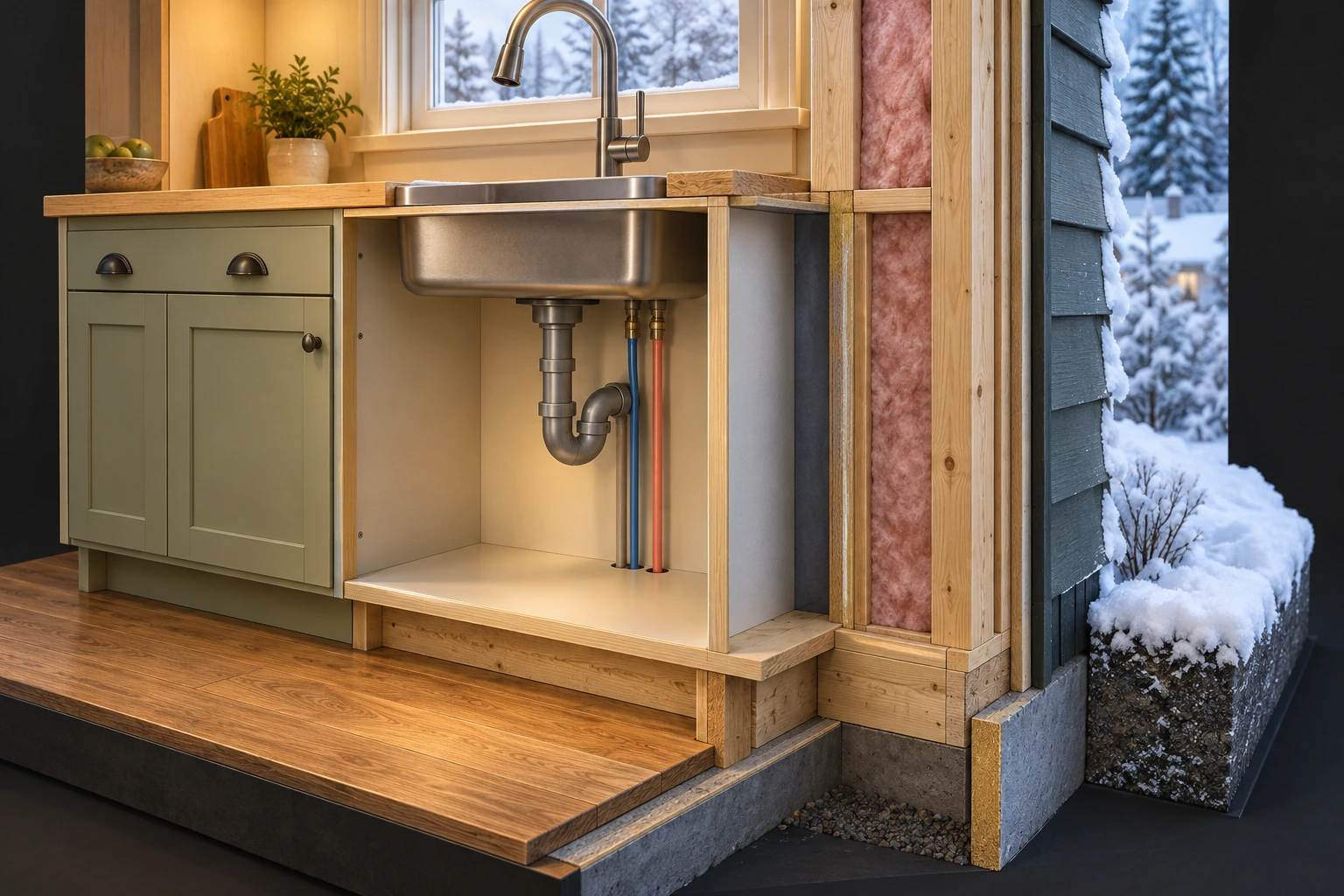
The slender supplies bring water to the tap; the larger curved drain carries used water away. Here the supplies sit at the back of a cabinet beside an outside wall. That location explains why the pipe can experience different conditions from the open room and its thermostat.
About this illustration
The front is removed to teach the parts. No actual pipe or room temperature, air movement, freezing, material identity, complete connection or approved wall assembly is shown. Blue and coral are teaching colours, not measured temperatures. This is a conceptual teaching model, not an assessment of your home.
4 picture lessons appear beside the questions in this guide. Use them to understand the explanation, then consider what it means for your home.
Why can plumbing freeze while the living room feels warm?
Your heating system warms rooms, but water pipes may run through colder places behind them. A kitchen can feel comfortable while a supply pipe sits beside an outside wall, behind a closed cabinet or in a poorly heated addition. Winter preparation starts with getting heat to the plumbing, not simply choosing a reassuring thermostat number.
If water has suddenly stopped, frost has appeared on a pipe, or a pipe is leaking, arrange prompt utility or plumbing help rather than waiting to finish this guide. For an active leak, use only a safely accessible shutoff already identified for that purpose. Stay out of wet areas near electrical equipment or other immediate hazards.
Heat moves from a warmer place to a colder one. Water can lose heat through the pipe and into colder surroundings; moving cold air can increase that exposure. NRCan explains these heat-transfer and air-leakage relationships. If the water gets cold enough for long enough, ice can obstruct the pipe and freezing can damage pipes or joints.
Picture a supply under a kitchen sink. The room is heated on one side, the outside wall is cold on the other, and the cabinet affects how readily room air reaches the plumbing. This is why municipal guidance discusses drafts, cabinet doors and local heating together. The useful question is what happens at this pipe location.
The buried incoming water service has a different exposure. Its surroundings are soil rather than kitchen air; Calgary identifies burial depth, frost depth and water temperature as relevant factors. Heating the kitchen does not establish protection for the whole underground service. Indoor branches and the incoming service need separate questions.
There is no reliable freeze countdown to read from an outdoor forecast. Route, heating, drafts, insulation and earlier trouble all matter. Start with a simple location record: where the pipe is, what surrounds it, whether that space normally receives heat, and which part you cannot see.
A heated kitchen can still have a colder pipe location
The slender supplies bring water to the tap; the larger curved drain carries used water away. Here the supplies sit at the back of a cabinet beside an outside wall. That location explains why the pipe can experience different conditions from the open room and its thermostat.
Numbers identify the parts explained below.
- Tap supplies
These smaller pipes serve the fixture. Water left between uses exchanges heat with its surroundings, including on a normally hot-water branch.
- Cabinet and outside wall
Room heat has to reach this location while heat can escape toward colder surroundings. Ask about drafts, heating and the whole concealed continuation.
- Separate sink drain
The larger curved pipe carries used water away. Keep supply protection and drainage questions separate when describing reduced tap flow.
What does this illustration leave out?
The front is removed to teach the parts. No actual pipe or room temperature, air movement, freezing, material identity, complete connection or approved wall assembly is shown. Blue and coral are teaching colours, not measured temperatures. This illustration explains an idea. It is not an installation guide.
How does heat reach the water supplies behind this cabinet, and what cold exposure continues beyond the part we can see?
Explore this with HomeAI ↗Opens an editable question. Nothing is sent until you choose to send it.Which water routes should I map before the cold arrives?
Follow the water by the job each part performs. The water main serves the street. The service pipe connects the property to that supply. Inside, the meter records water use, the main shutoff controls incoming water, and smaller supply branches feed fixtures and equipment. A private well uses a different supply arrangement and needs its own equipment-specific plan.
Cold-water branches serve taps and appliances; another supply feeds the water heater, which supplies hot-water branches. The drains carry used water away and are a separate plumbing system. On a map, label a pipe by its confirmed job rather than its colour or how large it looks. This prevents a drain or heating pipe from being mistaken for a drinking-water branch.
Begin with the visible entry, meter and identified shutoff in an ordinarily accessible utility space. Then note supplies near outside walls, cold cabinets, garages and additions. Calgary lists several of these locations for attention. You can document accessible rooms without entering an attic, crawl space or enclosed service void.
Add outdoor taps, irrigation and other seasonal water equipment as separate entries. For each, ask where its supply is isolated and what preparation its actual instructions require. A main shutoff is not a substitute for knowing which equipment a particular valve serves, especially in a shared building.
Use a photograph, a room name and a short note. For example: water entry visible in front utility room; rear kitchen branch concealed; irrigation preparation record requested. Mark the missing portion instead of drawing a convincing but invented connection. A plumber can use those specific gaps to scope an assessment.
Past records help prioritize the map. Ask where an earlier freeze occurred, what was changed and whether the problem returned. A receipt for one repaired branch does not describe every other branch. Buyers should request the same detail rather than accepting a general statement that the house was winterized.
Do hot pipes, insulation or a thermostat guarantee protection?
Hot water cools between uses. The fact that a tap normally delivers hot water does not keep the water sitting in its branch permanently warm. Calgary therefore includes both hot- and cold-water pipes in its cold-area insulation advice. Both need attention when their surroundings can become cold.
Insulation slows heat transfer; it does not create heat. A sleeve can help a pipe retain heat, but protection still depends on the conditions around the whole route. Ask whether a proposal addresses a cold space, a draft, an unprotected fitting or an inaccessible continuation. Buying thicker insulation without identifying the exposure may leave the important cause untouched.
Pipe insulation and stopping an unwanted cold draft do different jobs. One slows heat leaving the pipe; the other reduces incoming cold air. A qualified assessment may need to consider both, together with room heating. Do not block a vent, combustion-air opening or equipment clearance to make a pipe area feel warmer.
The thermostat controls heating using conditions at its own location. It does not measure the air behind every cabinet or inside every concealed cavity. Calgary and Winnipeg publish different local minimum-setting advice; neither becomes a guarantee for another home. Follow the applicable utility, equipment and insurer guidance while resolving actual cold spots.
An existing room sensor can show conditions where it is placed. Retain its location, times and alert history, and agree who will respond. It cannot establish every pipe temperature. Electrical heat tracing is also a product-and-installation question: ask a qualified provider about suitability, power, controls and maintenance rather than improvising a heating cable or temporary heater.
Insulation slows heat loss; the pipe still needs heat
Winter protection depends on heat arriving at the pipe as well as heat leaving it. Insulation slows transfer; it cannot replace missing space heat or resolve every cold draft. Follow the entire vulnerable branch when comparing a proposal.
Numbers identify the parts explained below.
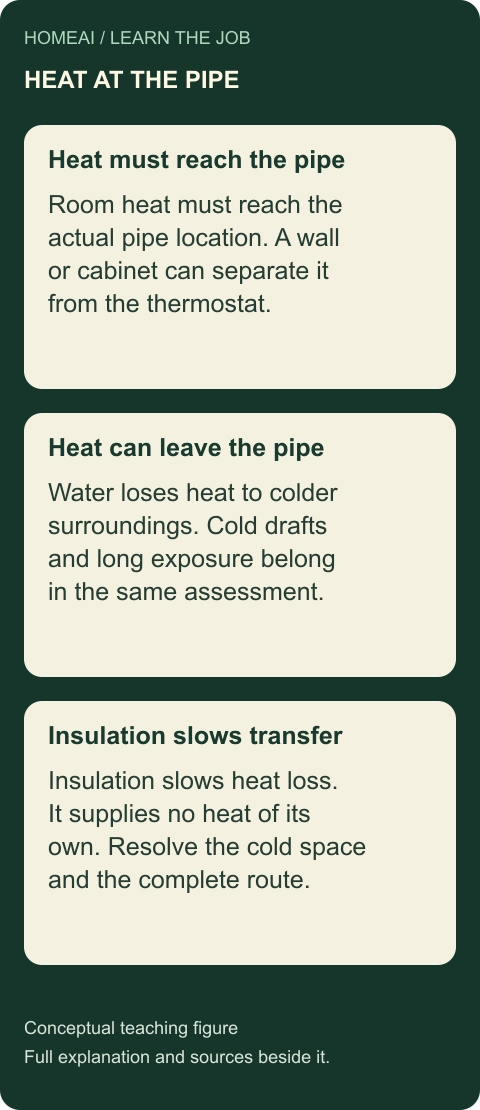
- Heat reaching the pipe
A comfortable room only helps the pipe when heat reaches its actual location. Cabinets, perimeter spaces and additions deserve their own assessment.
- Heat leaving the pipe
Water loses heat toward colder surroundings. Air leakage and the duration of exposure can matter alongside insulation.
- Insulation’s job
Insulation slows heat transfer. Ask which space, draft, fitting and concealed continuation the proposed work addresses, and what still depends on continued heating.
What does this illustration leave out?
These are qualitative heat relationships. No temperature threshold, heat rate, freeze time, insulation specification or product suitability is supplied. This illustration explains an idea. It is not an installation guide.
Does the proposed protection address the source of cold exposure and continued heat, or only cover one visible piece of pipe?
Explore this with HomeAI ↗Opens an editable question. Nothing is sent until you choose to send it.What should an outdoor-fixture winterization record explain?
An outdoor tap takes water from indoor plumbing to a location exposed to winter weather. Irrigation adds valves, buried branches, heads and controls; pools and fountains add still other equipment. Seasonal preparation needs to name the equipment involved because these are not all one tap with one shutdown instruction.
Toronto and Winnipeg both include disconnecting outdoor hoses and preparing outdoor supplies in their prevention guidance. Find the actual tap or system instructions and identify its permitted isolation point. The words frost-resistant describe a product feature, not confirmation that this installation and its seasonal preparation have been checked.
A useful service record explains which fixture or irrigation zone was prepared, where its supply was isolated, what preparation was completed and which components were outside the work. Ask how the service provider established the extent covered. A receipt saying house winterized leaves those practical questions unanswered.
Keep supplies that must remain available separate from seasonal supplies. The professional needs to account for water-using appliances, heating-related equipment, private-well components and any shared or fire-protection systems. Do not copy an outdoor-tap procedure to a whole building or change a shared system yourself.
Agree the spring handover as well: who will restore the equipment, what checks the installed instructions require, and who to contact if leakage appears. This guide does not give a compressed-air blowout, antifreeze dose or universal drain-down sequence. Those choices depend on the equipment and site, not the appearance of an illustration.
The outdoor tap and its supply need a seasonal plan
The outdoor tap provides water outside; the indoor branch supplies it. The separate valve illustrates why seasonal preparation must identify the correct branch and equipment. Municipal advice includes disconnecting hoses, while the actual tap and system instructions determine the rest of the preparation.
Numbers identify the parts explained below.
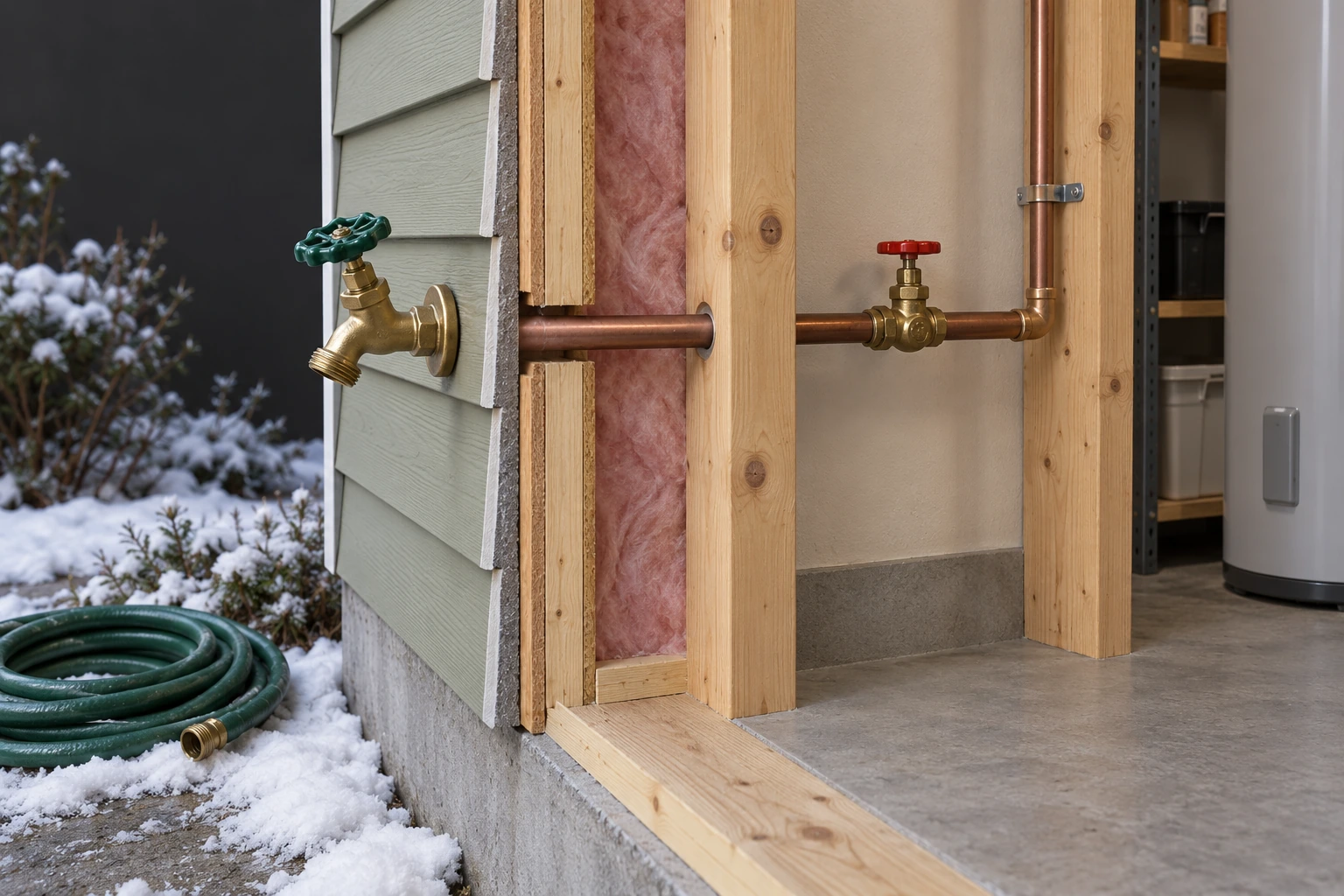
- Outdoor tap
This fixture reaches the weather-exposed side of the house. Identify its model and seasonal instructions instead of assuming that the words frost-resistant settle the preparation.
- Indoor branch control
A separate branch valve can have a different job from the main shutoff. Have the actual control identified and account for systems that must stay supplied.
- Disconnected hose
The hose is visibly separate in this example. A hose-removal task does not document preparation of all taps, irrigation or water-using equipment.
What does this illustration leave out?
The picture gives no frost-resistant valve mechanism, drainage slope, confirmed valve position, complete winterization sequence or approval. The shown relationship is conceptual; do not use it to choose or operate an unidentified valve. This illustration explains an idea. It is not an installation guide.
Which outdoor fixture and branch were prepared, what instructions applied, and which parts were outside the work?
Explore this with HomeAI ↗Opens an editable question. Nothing is sent until you choose to send it.Which shutoff is mine to use, and who controls the service?
A shutoff stops incoming water through the route it controls. A fixture valve may isolate one tap; the interior main valve controls the home’s incoming supply; a utility curb-stop controls the service outside under the utility’s procedures. Knowing which is which before a leak makes the response less confusing.
Closing a supply valve does not itself empty every pipe or prepare every appliance for winter. Ask a plumber what remains filled, what the installed equipment needs and which systems must stay supplied. An absence plan and an emergency leak response have different purposes; they should not be reduced to the same internet shutdown sequence.
Have the interior main valve identified while conditions are normal. Keep the approach clear and record its location in words someone else can follow. If its identity, condition or operation is uncertain, arrange professional help. Do not force a corroded or seized valve to demonstrate that you can turn it.
EPCOR Edmonton distinguishes the household valve from its utility-operated curb-stop. It directs multi-residential residents to their building manager. In a condominium or rental, obtain the building’s actual isolation and reporting procedure, including the after-hours contact. Do not assume an outside cap or a neighbouring unit’s valve is yours to operate.
The point where responsibility changes also needs local confirmation. Toronto describes a City service portion to the property line and an owner portion from there into the home. Meter responsibility and repair arrangements can differ elsewhere. Use your utility’s records and building arrangement; the curb, meter or line on a conceptual picture is not a legal boundary.
Should I leave a tap running during every Canadian cold spell?
Water use brings supplied water through the route serving the open fixture. That is the reason some utilities use continued flow as a particular prevention measure. It does not send water through every unused branch, establish safe drainage or replace protection for cold indoor locations.
Follow the current instructions for this address and provider. Calgary’s Frozen Pipes Prevention Program gives identified customers start and stop letters. Winnipeg says not to run water continuously unless the City advises it. Toronto’s page discusses an optional running-water measure and water charges. These are different local instructions, not a nationwide rule.
If a notice applies, keep it with the property record. Confirm the instructed tap, flow, start date, monitoring, drainage, billing and stop direction with that provider. Do not copy Calgary’s programme flow or billing arrangement to an Edmonton, Winnipeg, Toronto or private-well property.
In Calgary’s programme, a warmer afternoon or chinook does not replace the stop letter. The City explains that soil around a service can remain frozen after the air warms. The buried service is responding to ground conditions, which may not match the weather you feel at the front door.
No letter is not proof that every indoor pipe is protected. An identified service-line programme and an exposed kitchen branch are different concerns. If general advice conflicts with a property-specific direction or an isolation plan, ask the provider and responsible plumber to reconcile it before changing the arrangement.
Running a tap is a local instruction, not a Canadian rule
A utility may direct continued flow for an identified service problem. It brings supplied water through the route serving that fixture, not every branch in the house. Calgary’s property letters and Winnipeg’s general advice show why the address and current provider instruction matter.
Numbers identify the parts explained below.
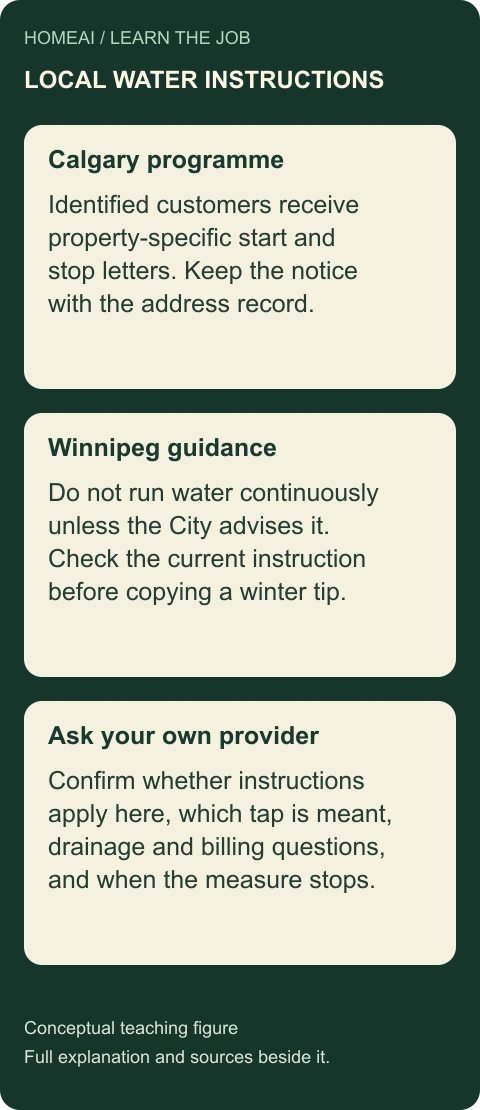
- Calgary programme
Keep the property-specific start and stop letters together. Warmer afternoon air does not independently replace the programme’s stop instruction.
- Winnipeg guidance
The City says not to run water continuously unless it advises you. Confirm the current local direction rather than copying another municipality’s tip.
- Your own provider
Ask whether a notice applies, which fixture and route it concerns, how drainage and charges are handled, and when the measure ends.
What does this illustration leave out?
Municipal examples were read October9,2026. They give no programme eligibility, stream size, bill credit or protection guarantee for another address. Toronto discusses its own optional measure and charges in the linked primary guidance. This illustration explains an idea. It is not an installation guide.
Does a current water-provider instruction apply to this address, and what exactly does it ask the occupant to do?
Explore this with HomeAI ↗Opens an editable question. Nothing is sent until you choose to send it.What should change when the home will be unattended?
An occupied home gives people chances to notice a cold room, failed heating or changed tap flow. During an absence, the plan must replace that informal observation with a named person and an agreed response. A sensor notification is useful only if someone receives it and knows what to do next.
Before leaving, agree the ordinary heating arrangement and resolve known cold plumbing locations. EPCOR’s absence advice retains home heating. Calgary and Winnipeg point owners to their actual insurance policies for monitoring or visits. Ask your insurer what this policy requires; there is no universal visit interval or automatic coverage assurance in this guide.
Give the visitor clear locations and contacts: where the heating status is visible, which safely accessible rooms deserve attention, where the identified main valve is, and whom to call. Retain dates and observations. The visitor should not need to service equipment, enter a confined space or cross a wet electrical area to complete the check.
A temperature alert and a leak alert answer different questions. One reports conditions at a sensor; the other reports water reaching a detector. Neither establishes that a hidden branch stayed warm. Ask whether a known vulnerable location needs additional qualified assessment rather than assuming a whole-home smart device covers every pipe.
Decide with the appropriate professional whether water should remain supplied or whether a planned isolation and preparation is suitable. Account for appliances, heating and other water-dependent equipment, any utility notice, and the restart. Closing one valve without addressing those dependencies is not a complete winter plan.
Plan who responds if power or heating stops. Keep the utility, heating contractor and plumber contact details available outside the home as well. During an actual outage, use local emergency guidance; do not bring outdoor combustion equipment indoors or improvise a pipe-thawing heater.
Does missing hot or cold flow prove that a pipe is frozen?
No. Flow means water arriving at a fixture; a change tells you something has changed along that supply or at the fixture itself. EPCOR lists fixture blockage, valve position, water-heating or treatment equipment, utility activity and freezing as possible explanations. Do not label every weak winter tap a frozen service.
A change at one fixture gives a different starting question from a loss throughout the home. A hot-only change directs attention to the hot-water route or equipment, while a change to both hot and cold may have a different extent. These patterns help describe the service request; they do not locate a hidden blockage.
Use observations from safe ordinary use: which fixtures changed, hot or cold, when it began and whether recent work preceded it. Check the utility’s current outage information. Do not dismantle the heater, alter treatment bypasses, force valves or repeatedly run taps when drainage is uncertain just to complete a diagnosis.
Treat suspected freezing promptly. Tell the plumber or utility about accessible frost, an unusually cold location, loss of heating and earlier freezes. Ask whether the incoming service, an indoor branch or the fixture requires assessment. A frost photograph supports that concern but cannot show the complete affected extent.
If water is leaking, the immediate question is safe isolation and help. Use only a safely accessible valve already identified for that purpose; do not force it. Keep away from water near electrical equipment, unsafe ceilings and confined spaces. Contact the appropriate emergency service for an immediate hazard and the building manager where a shared system is involved.
Do not use a torch, open flame or improvised electrical or portable heating equipment to investigate or thaw pipes. This guide provides no DIY thawing sequence. A qualified provider must assess access, damage and the appropriate work, and explain what to watch for after service returns.
How would a fictional owner use these records?
Consider a fictional owner preparing for a winter trip. The living room feels warm, but an old invoice mentions a kitchen supply near a rear addition. The owner does not know whether that branch was moved or merely repaired. A hose is still connected outside, and the main water valve has not been identified.
The owner separates three tasks: understand the kitchen branch’s cold exposure; prepare the actual outdoor fixture; and obtain safe main-valve identification with the home’s water dependencies explained. The plumber’s agreed scope names those tasks. It does not imply inspection of every hidden pipe or approval of the whole home.
The completed record describes what was assessed, what preparation was done, any remaining concealed portion and which instructions the visitor needs. The owner also confirms the actual insurer’s absence requirements and checks whether a current utility notice applies. The visitor receives an after-hours heating and plumbing contact plan.
During the trip, the visitor reports reduced kitchen cold-water flow while another fixture behaves normally. The house thermostat still appears normal. The owner reports the time, affected fixture and earlier addition record, checks utility information and arranges prompt assessment. The comfortable thermostat does not settle the kitchen question.
Two explanations remain open: a local fixture or valve restriction, and a cold-exposed distribution branch. The professional must establish the cause and affected extent. If a problem is found, the completion record should connect the finding to the actual repair and prevention advice. No thawing method, invented temperature, price or guaranteed outcome is supplied.
What evidence should close the winter-preparation loop?
A useful closeout answers what was wrong, what changed and what the home still depends on. Ask the specialist to name the assessed route or equipment, the finding, the completed work and the remaining concealed extent. A line saying pipe insulated is less useful than a record locating that section and explaining the cold exposure it addresses.
Keep preparation records separate from incident records. Preparation records identify seasonal equipment, isolation, heating and monitoring arrangements. Incident records identify the affected fixtures, timing, investigation and any verified freezing or leakage. That distinction helps a future owner understand whether a task was routine care or a response to a recurring problem.
If service was restored, ask how damage and leakage were checked within the provider’s scope and what follow-up is needed. Water returning at a tap establishes restored flow at that time. It does not establish that every concealed joint is undamaged or that the original exposure has been corrected.
Retain the actual product instructions, any required work or inspection documentation, utility notices and the provider’s recommendations. Check that a proposed improvement fits the installed arrangement and local requirements; this guide supplies no national burial depth, pipe-insulation thickness, heat-cable specification or code approval.
Revisit the plan after a kitchen renovation, changed heating arrangement, new water equipment or an altered absence routine. Give the next occupant the shutoff location, seasonal tasks, unresolved questions and relevant contacts. The goal is a home whose water system and winter dependencies are understood, rather than a folder of reassuring but unexplained receipts.
Keep learning about the connected parts
Keep learning about the connected parts
Practice the distinction.
A winter trip with three practical gaps
Fictional learning scenario: a kitchen branch’s cold exposure, outdoor-tap preparation and the main shutoff need attention before a trip.
Reported observations
- The occupied-room thermostat appears normal.
- An earlier invoice mentions a kitchen supply near an addition without explaining the complete route or later protection.
- During the trip, reduced kitchen cold-water flow is reported while another fixture behaves normally.
Compare the explanations
Expand each possibility to see the evidence needed to distinguish it. Similar symptoms can have different mechanisms.
A local fixture or valve issue
A restriction at the fixture or its local supply can change flow without freezing.
Qualified fixture and valve assessment, recent work record and affected-fixture chronology.
A cold-exposed indoor branch
The addition record makes the branch’s heating and cold exposure worth investigating; the room thermostat does not measure that location.
Professional route and exposure findings, any verified freezing or damage, and the assessed limits.
A useful next question
Resolve the preparation tasks before departure; if flow changes, promptly supply the specific observations to the plumber or utility.
The example establishes neither a real property finding nor a universal shutdown sequence, freeze threshold or DIY thawing method.
Know what the words mean.
- Water service
- The incoming pipe connection bringing supplied water to the property. Confirm its ownership and operating boundaries with the local provider.
- Distribution piping
- The indoor supply branches carrying water to taps, appliances and other equipment. Drains carry used water away and do a different job.
- Winterization scope
- The exact taps, equipment and supplies covered by seasonal preparation, including isolation, remaining water dependencies and restart instructions.
- Curb-stop
- An outside valve used to isolate the incoming service under the local utility’s procedures. Arrange utility help rather than operating an unfamiliar outside cap.
Questions to bring
to the conversation.
- Where does the water enter, and which branches pass near an outside wall, cold cabinet, garage or addition?
- How will heat reach those locations, and what is the plan if heating or power stops?
- Which outdoor taps and irrigation components were prepared, using which equipment instructions?
- Who may operate the identified shutoff, and which systems depend on water remaining available?
- Does this address have a current utility notice, and who will respond during an absence?
Separate a showing observation, an existing record and a new professional assessment. Unknown means a question remains; it does not automatically mean a defect.
Use the evidence planner ↗Go to the source.
Original HomeAI explanation informed by these public references. Sources support the underlying guidance; they have not reviewed or endorsed HomeAI. Diagrams are conceptual, and calculator outputs depend on your inputs.
Publication & source review
First published .
Sources reviewed .
- City of Calgary · Protect water lines and meters from freezing (Calgary guidance)
Where this reference applies
Jurisdiction: Calgary, Alberta
Source reviewed: 2026-10-09
Indoor exposure, service-line factors, prevention and urgent reporting; not a national thawing procedure.
- City of Calgary · Frozen Pipes Prevention Program (property-specific letters)
Where this reference applies
Jurisdiction: Calgary, Alberta
Source reviewed: 2026-10-09
Locally identified water-service customers and start/stop letters; no nationwide running-water or billing entitlement.
- EPCOR Edmonton · Prevent frozen water pipes
Where this reference applies
Jurisdiction: Edmonton, Alberta
Source reviewed: 2026-10-09
Local prevention and professional assistance; this guide does not reproduce equipment-assisted thawing directions.
- EPCOR Edmonton · Main shutoff and utility curb-stop valves
Where this reference applies
Jurisdiction: Edmonton, Alberta
Source reviewed: 2026-10-09
Local valve identification, utility operation and multi-residential coordination; ownership must be confirmed locally.
- EPCOR Edmonton · Causes of low water pressure
Where this reference applies
Jurisdiction: Edmonton, Alberta
Source reviewed: 2026-10-09
Fixture, valve, equipment and utility alternatives; no cause can be established from a flow pattern alone.
- City of Toronto · Prevent or thaw frozen pipes (Ontario municipal guidance)
Where this reference applies
Jurisdiction: Toronto, Ontario
Publisher modification date: 2026-09-16
Source reviewed: 2026-10-09
Local public/private service division and prevention; electrical and flame thawing steps are excluded from this guide.
- City of Winnipeg · Prevent frozen pipes (Manitoba municipal guidance)
Where this reference applies
Jurisdiction: Winnipeg, Manitoba
Source reviewed: 2026-10-09
Local exposure and winter preparation; no universal thermostat setting or insurance visit interval.
- City of Winnipeg · When continuous running water is advised
Where this reference applies
Jurisdiction: Winnipeg, Manitoba
Source reviewed: 2026-10-09
Current local instruction against continuous running unless advised by the City; statistics are not used as parcel predictions.
- NRCan · Keeping the Heat In, section 2: how your house works
Where this reference applies
Jurisdiction: Canada; building-science education
Publisher modification date: 2025-01-14
Source reviewed: 2026-10-09
Heat moves from warmer to colder places; insulation slows heat transfer and air leakage changes exposure. No pipe freeze timer, retrofit specification, national thermostat threshold or code-adoption claim is derived.
- City of Toronto · Pipe leak or burst
Where this reference applies
Jurisdiction: Toronto, Ontario
Publisher modification date: 2017-11-17
Source reviewed: 2026-10-09
Local main-valve isolation and plumber/utility roles; no response-time promise, current fee or national ownership rule is repeated.
Have a question about your home?
Start with the symptom, timing and what you have observed.
Ask HomeAI