- Identify the complete wastewater arrangement and its design/service records.
- Pumping, tank observation and treatment-area assessment have different scopes.
- Have qualified local specialists assess intended use, access and unresolved conditions.
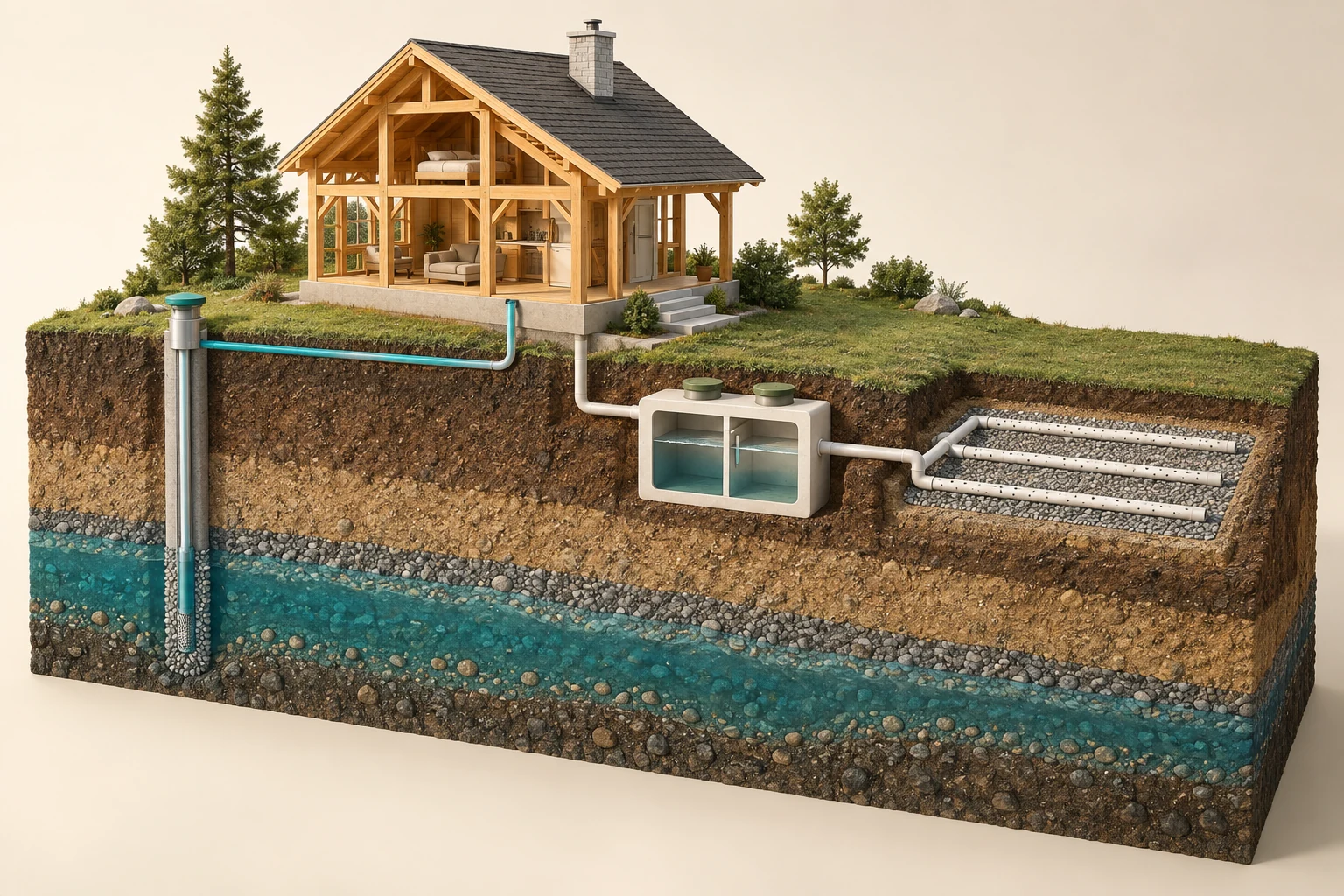
Conceptual architecture. Layout, sizes and routes are illustrative; the picture does not describe your home’s condition.
Explore this picture study ↗4 picture lessons appear beside the questions in this guide. Use them to understand the explanation, then consider what it means for your home.
Start with the wastewater arrangement, not the lawn
A home outside a municipal sewer network may use a conventional septic system, a more complex treatment installation, a holding tank or a shared arrangement. Ask what serves this particular building and where each component is located. The property description may use septic as shorthand without distinguishing the treatment process. Request drawings, installation or approval information, maintenance plans and later modifications. Match the address, system identity and dates rather than treating any wastewater invoice in the seller’s folder as evidence for the present arrangement.
The complete system matters to a buyer because the tank is not the whole treatment path. In a conventional arrangement, wastewater separation and subsequent soil treatment serve different functions. Other systems can add pumps, controls or treatment equipment. Ontario’s SepticSmart and British Columbia’s owner resources explain these distinctions within their jurisdictions. Use them to learn the questions, then confirm the applicable process locally. A neat lawn or an unobtrusive lid cannot establish the condition, capacity or authorization of everything underground.
Understand separation, treatment and the receiving ground
A conventional tank retains material that should not simply be sent onward with liquid effluent. The downstream distribution and soil treatment area must then perform their own roles. This makes solid accumulation, liquid loading and the receiving site relevant in different ways. Pumping can remove accumulated material from a tank, but it does not by itself establish that the distribution system or treatment area is functioning as intended. Have the provider explain which components were actually examined and which service was performed.
The ground is part of an onsite treatment assessment. Soil conditions, water levels, site layout and the actual system design can affect the question a specialist needs to investigate. A surface photograph cannot establish the soil profile or an acceptable design. Request the relevant site investigation and as-built information if available. Do not dig exploratory holes, open tanks or enter any wastewater space. These locations can involve serious gas, access and collapse hazards; qualified providers must manage inspection methods and permissions.
Tank separation and receiving-ground treatment do different jobs
A house route reaches a sectioned tank with upper, middle and lower layers beneath closed green covers. A downstream display shows perforated-looking pipes in gravel above soil. The broad section is a fictional teaching layout.
Numbers identify the parts explained below.

- Separation specimen
Floating and settled material introduce a tank function separate from the liquid leaving it. A clean-looking illustrated layer is no tested effluent or tank-condition finding.
- Distribution specimen
The downstream pipes introduce another component scope. Their displayed holes and spacing do not specify an installed distribution design or measured operation.
- Receiving-ground specimen
Further treatment in the receiving ground is a separate question. Soil appearance in this model supplies no site investigation, suitable design or performance result.
What does this illustration leave out?
The layers illustrate separation rather than measured contents or condition. No actual tank volume, pipe grade, working distribution, trench depth, soil profile, groundwater level, effluent quality, design approval or treatment performance is established. This conventional concept does not identify every Canadian arrangement. The virtual section is not permission to uncover, open or enter a real system. This illustration explains an idea. It is not an installation guide.
Which records and qualified findings address the tank, downstream distribution and receiving treatment area separately for this actual system?
Explore this with HomeAI ↗Opens an editable question. Nothing is sent until you choose to send it.Connect the intended household with the design assumptions
Describe how you intend to use the property: year-round occupancy, additional rooms, a suite, a home business or seasonal visitors. Ask whether the available design and approvals address that intended arrangement. A seller’s statement that the system worked for them is history, not an assessment of every future demand. Equally, a larger household does not let a chatbot conclude that replacement is required. A qualified local assessment needs the actual system, design basis, site constraints and proposed changes.
Changes elsewhere in the house can matter to the wastewater question. A renovation may alter use or water demand while the buried system remains the same. Keep building-permit documents and sewage-system records linked but distinct. Ask the relevant authority and specialist what an expansion would require for this address before relying on a conversion budget. A listing’s room count and an informal assurance of spare capacity cannot replace that answer. Record any conclusion with its assumptions so the planned use is not lost in a generic condition summary.
Read service receipts without expanding their meaning
A pumping receipt can identify date, provider and the work invoiced. Ask whether it also records the accessed components, observed conditions, measurements or recommendations. It may not include a treatment-area assessment, controls testing or comparison with the original design. Preserve the original wording. Do not rewrite pumped last year as inspected and certified last year. If the seller describes additional work, request the matching report or invoice rather than assuming it was included in the pumping visit.
Build a timeline of available installation, pumping, repair and maintenance records, showing which component each refers to. A missing invoice is an evidence gap, not proof of neglect. Repeated service can have several explanations that need context. Ask the provider or owner what prompted the visits and whether the results or unresolved recommendations are documented. Where operating equipment needs a maintenance plan, obtain that actual plan instead of imposing a generic national pumping interval. The appropriate routine depends on the system and local guidance.
A service task and a whole-system assessment have different scopes
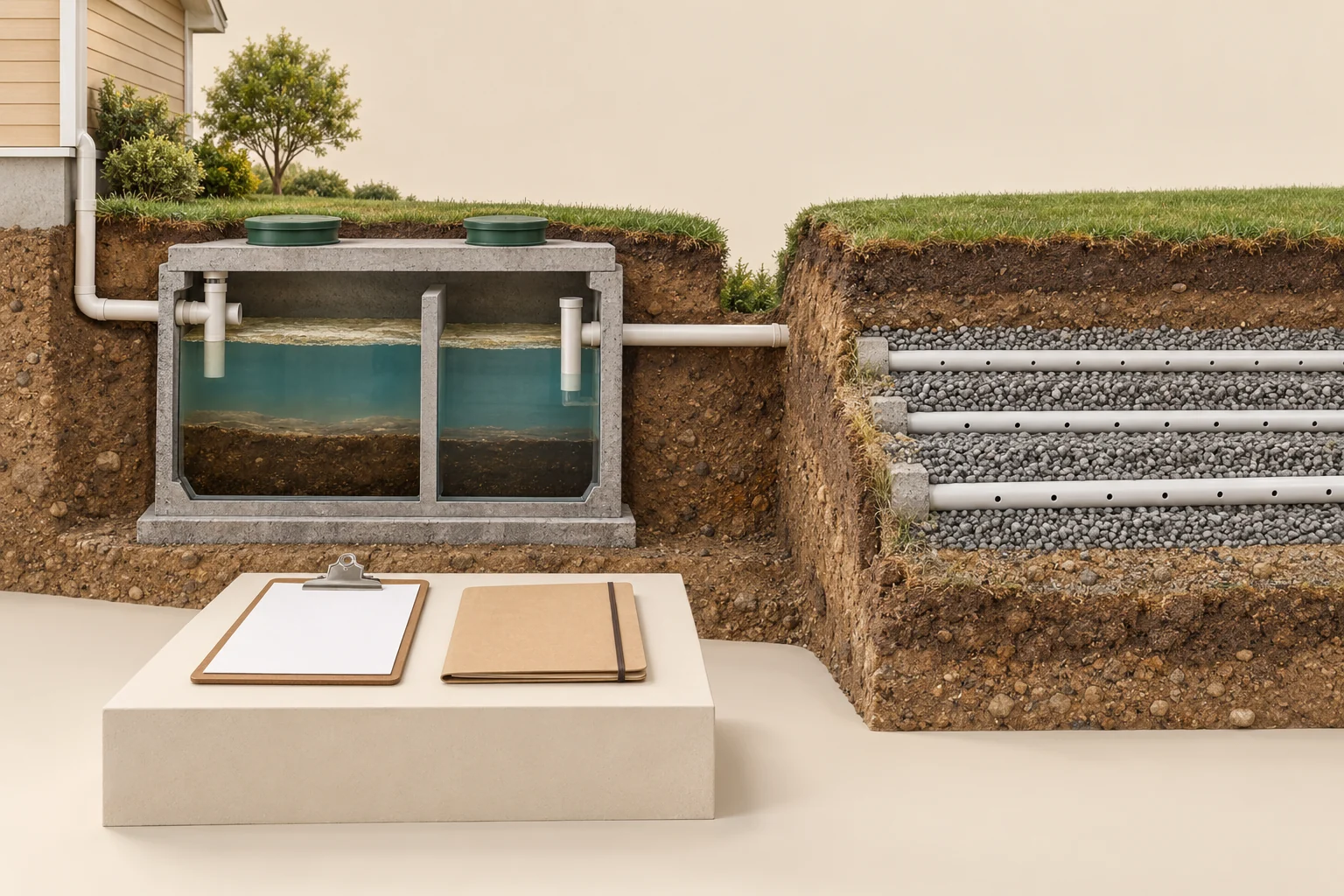
The tank section displays layers below closed green covers. Its outlet stops beside a gap separating the downstream pipe-and-gravel display. A blank clipboard and closed blank booklet sit in front.
Numbers identify the parts explained below.
- Tank-task landmark
A pumping or service record should name the actual component and task. Removing accumulated material answers a narrower question than assessing the complete downstream system.
- Separate downstream scope
The field specimen keeps distribution and receiving-ground questions visible. The display gap is not a defect finding; ask what downstream evidence the real engagement included.
- Blank service record
Keep the original task, date, provider, assessed reach, findings and exclusions. Blank pages cannot turn an invoice into a whole-system guarantee.
What does this illustration leave out?
The gap separates virtual display sections; it is not a depicted disconnected or damaged real pipe. No service has occurred and the blank paperwork proves no pumping, inspected reach, certification, removed quantity, condition, maintenance interval or assessed treatment-area performance. The cutaway is an illustration, not an access method or installation design. This illustration explains an idea. It is not an installation guide.
What task and components does this pumping or service record actually cover, and which downstream conditions or intended-use questions remain outside it?
Explore this with HomeAI ↗Opens an editable question. Nothing is sent until you choose to send it.Treat visible symptoms as prompts for professional findings
With permission and from safe ground, record unusual wet areas, odours, visible settlement or reported backups without disturbing the system. Note weather, location and whether the concern is current or historical. Wet ground can have more than one source, and a plumbing backup does not by itself identify the failing component. The useful buyer question is what assessment could distinguish those explanations. Keep people away from sewage contamination and insecure openings, and seek appropriate professional or public-health guidance for an active concern.
A freshly cut yard during dry weather may conceal little or simply reveal little. Snow, saturated ground, recent pumping, restricted access and inactive occupancy can limit a visit. Ask the assessor to document those conditions and explain their effect on the interpretation. Do not request a hazardous improvised load test to overcome uncertainty. A responsible report can identify what was assessed now and what additional information would be needed; it should not guarantee that the system will perform through every future season.
A wet patch needs context before it gets a cause
A wet-looking patch interrupts the foreground grass. A house downspout, two closed green covers and a shallow swale-like depression give separate surface landmarks. No buried route is exposed.
Numbers identify the parts explained below.

- Surface observation
From safe accessible ground, preserve the actual location and timing. Wet-looking grass alone cannot identify wastewater or the cause.
- Weather and drainage context
The downspout and right-hand depression prompt separate surface-water questions. This illustration traces no verified flow between them and the patch.
- Closed access landmarks
Keep real covers closed and record access limitations. A nearby cover does not establish which component or buried route relates to the observation.
What does this illustration leave out?
The scene identifies no sewage, actual connection, failed component, contamination, cause or safe contact. The downspout and depression are possible context rather than proven sources. Weather, occupancy, service history and qualified findings remain separate evidence. Do not touch or probe the patch, open covers, dig or stage a load test; keep people clear of actual contamination or insecure openings. This illustration explains an idea. It is not an installation guide.
Which ordinary weather, location and occupancy records would help a qualified provider distinguish explanations for this wet area without disturbing the system?
Explore this with HomeAI ↗Opens an editable question. Nothing is sent until you choose to send it.Define the assessment deliverable before arranging access
Clarify who is qualified for the applicable local system and which questions the engagement will cover. A general home inspector, pumping contractor and sewage-system designer may offer different services. Ask whether records, tank condition, mechanical components, distribution and treatment-area evidence are included, and what methods are proposed. Identify whose permission is needed to access or uncover components and who will restore disturbed ground. The agreed scope should make inaccessible elements and exclusions visible in the final written report.
Request findings that distinguish direct observation, records reviewed, professional interpretation and recommendations. If a report proposes repair or further investigation, ask for the reason, alternative explanations and dependencies. A price quote answers a scope-and-cost question; it does not establish who is responsible under the purchase agreement. Have your transaction advisors address contractual timing and options separately. If a necessary assessment cannot be completed within the deadline, preserve the unknown in the decision rather than promoting a limited visit into comprehensive evidence.
Look beyond the tank footprint
Ask how the system relates to wells, boundaries, nearby water, access routes and proposed landscaping. Keep any survey, site plan or sharing arrangement attached to the system record. A neighbouring installation or an apparent clear patch in the yard does not establish a lawful reserve area or suitable replacement location. Have the appropriate specialist and authority evaluate the site-specific questions. Do not apply a setback quoted on a different province’s webpage as a national rule or measure your way to an unsupported compliance conclusion.
Future access is also a practical ownership question. A deck, addition, driveway or heavy vehicle route can complicate service or alter conditions around a buried system. Ask for the actual component locations before planning those works. If the system is shared, request the maintenance, cost and access arrangements and obtain advice on their meaning. A verbal understanding may not settle legal responsibility. The technical dossier should describe the system; the relevant documents and professional advice should describe the rights and obligations.
A site picture and actual service-location records answer different questions
The house and ground are virtual sections. A well-casing specimen appears at left; two green covers remain closed in the lawn. A right-hand gravel path and blank paper specimens sit apart from these service landmarks. No hidden wastewater pipe is visible.
Numbers identify the parts explained below.

- Closed system landmarks
Match actual system components and treatment-area locations to original records. The well specimen and green covers do not define an appropriate separation or concealed wastewater arrangement.
- Access and future-use question
The gravel path is not verified vehicle access. Ask how real service access and proposed yard work relate to documented buried components and treatment land.
- Blank location dossier
An original site record, as-built drawing, relevant survey and any sharing agreement answer different questions. These blank props supply none of those findings or rights.
What does this illustration leave out?
The layout supplies no actual locate, wastewater route, treatment-area extent, legal boundary, sharing right, access permission, reserve area, safe vehicle access, suitable addition or national separation distance. The well section reveals no actual construction or water result, and the blank sheet is no survey or as-built record. This is a site-question illustration, not an approved plan. This illustration explains an idea. It is not an installation guide.
Which original system-location, site and access records should the local specialist review before a driveway, deck, addition or other change around these buried services?
Explore this with HomeAI ↗Opens an editable question. Nothing is sent until you choose to send it.Make the rural handover a complete operating record
A seller can provide a much clearer handover by grouping system identity, available design and approvals, full service reports, manuals and unresolved recommendations. Keep completed work distinct from proposed work. If a correction is arranged for the transaction, specify the scope and the evidence that will demonstrate completion through the appropriate professionals. A paid invoice should not erase an earlier report qualification or become a guarantee about components that were outside the repair.
Buyers should carry the same record into their maintenance plan if they proceed. Know whom to contact, what the specific maintenance instructions require and which warning signs warrant prompt help. Follow local guidance and manufacturer instructions for the actual equipment. HomeAI can explain the treatment chain and help assemble a specialist brief, but it cannot inspect a tank remotely, verify subsurface conditions, determine available capacity from occupancy alone or approve a property’s wastewater arrangement. The decision should rest on documented scope and the remaining uncertainty.
A simple component index can make the dossier easier to use: identity, available record, latest assessed scope and unresolved question for each part. It should include shared or inaccessible elements where relevant, rather than only the tank. If a later specialist changes the interpretation, attach that explanation and its evidence without rewriting the historical service entry. A clear record is more durable than a one-word pass mark and more useful to the next qualified provider.
Keep learning about the connected parts
Practice the distinction.
Pumped does not mean fully assessed
A fictional seller supplies a pumping invoice and proposes adding an extra living space.
Reported observations
- The receipt identifies a tank visit.
- The treatment-area design and proposed-use assessment are missing.
Compare the explanations
Expand each possibility to see the evidence needed to distinguish it. Similar symptoms can have different mechanisms.
Useful maintenance evidence
The receipt may document a legitimate service without answering the expansion question.
Full service record and access scope.
Unresolved design question
The future use needs comparison with the actual system and site.
Qualified local assessment using available design records.
A useful next question
Request the missing system and intended-use evidence before assuming spare capacity.
This scenario establishes neither failure nor a replacement requirement.
Know what the words mean.
- Effluent
- Liquid leaving a particular wastewater treatment stage; the term does not mean it is drinking water.
- Treatment area
- The documented area and components performing the downstream treatment function for the particular system.
- As-built record
- A record describing what was actually installed, with its date and scope.
Questions to bring
to the conversation.
- Which components and treatment area are actually documented?
- What household use and site assumptions supported the system?
- Which components will the assessment reach, and what remains concealed?
- What does the pumping or service receipt prove, and what does it omit?
Separate a showing observation, an existing record and a new professional assessment. Unknown means a question remains; it does not automatically mean a defect.
Use the evidence planner ↗Go to the source.
Original HomeAI explanation informed by these public references. Sources support the underlying guidance; they have not reviewed or endorsed HomeAI. Diagrams are conceptual, and calculator outputs depend on your inputs.
Publication & source review
First published .
- Government of Ontario · Septic systems
- Government of Ontario · SepticSmart: understanding your home wastewater system
- Province of British Columbia · Onsite sewage system guidelines and owner resources
- Health Canada · Test your well water
- Natural Resources Canada · Flood mapping types and process
- HealthLink BC · Tank, dispersal and receiving-soil functions
Where this reference applies
Jurisdiction: British Columbia
Edition: HealthLink BC File21; last updated 2025-03-12
Source reviewed: 2026-10-05 · America/Edmonton
Typical tank separation, downstream soil treatment, maintenance plans, component drawings and yard context. The BC practitioner/filing framework is regional; no pictured layout establishes capacity, performance or a national service interval.
- CCOHS · Confined-space hazards and professional access
Where this reference applies
Jurisdiction: Canada; workplace confined-space context
Edition: Fact sheet last revised 2025-03-12
Source reviewed: 2026-10-05 · America/Edmonton
Wells and tanks can have serious atmosphere, access and rescue hazards. Observe only from safe accessible ground; this guide supplies no entry, gas-testing or rescue procedure.
- Fraser Health · Onsite-system records and property-owner resources
Where this reference applies
Jurisdiction: Fraser Health region, British Columbia
Edition: Current resource page; no whole-page modification date shown
Source reviewed: 2026-10-05 · America/Edmonton
A regional system-file request route is separate from an actual property record, location or assessment. Linked forms have their own requirements; this resource page establishes no property approval or Canada-wide request process.
Have a question about your home?
Start with the symptom, timing and what you have observed.
Ask HomeAI